Lab Supplies

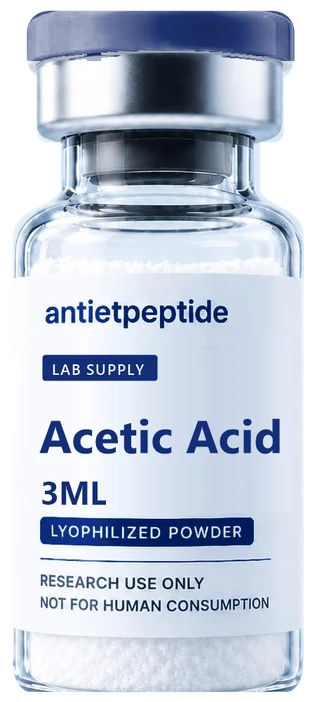
Acetic Acid Solution

0.6% acetic acid for laboratory use, 3 ml and 10 ml vials.

$20
Box of 10 vials · 3 ml each · Cat. No. AA3
Size
Volume pricing 5% off from $1,000, rising to 25% above $10,000. Applied automatically at checkout. Details →
1
Every batch tested and numbered
US warehouse delivery in 5 to 7 days
Sealed vials, 10 to a box
Factory-direct pricing

Research use only. Supplied for in vitro laboratory research. Not for human or veterinary use, and not a drug, food, cosmetic or supplement.

This is dilute acetic acid at 0.6%, supplied as a laboratory solvent for peptides that dissolve poorly in water alone.

The chemistry is straightforward. Many peptides carry basic residues such as lysine, arginine and histidine, and a mildly acidic solution protonates those side chains, increasing charge and improving solubility. Peptides with a high proportion of hydrophobic residues often need it.

Acetic acid is preferred over stronger acids because it is volatile, so it can be removed by lyophilisation without leaving a residue, which counts when the solvent must not persist into the next step.

Supplied in 3 ml and 10 ml vials.

Selected research

  • Wright BS (1987). Immunoprecipitation of the parathyroid hormone receptor. Proc Natl Acad Sci U S A. PubMed 3025860
  • Yvon M (1989). Solubility of peptides in trichloroacetic acid (TCA) solutions. Hypothesis on the precipitation mechanism. Int J Pept Protein Res. PubMed 2599755
  • Joo HS (2014). The isolation and analysis of phenol-soluble modulins of Staphylococcus epidermidis. Methods Mol Biol. PubMed 24222457
  • Hamel FG (1986). High performance liquid chromatographic analysis of insulin degradation by rat skeletal muscle insulin protease. Endocrinology. PubMed 3510119
  • Vincent PL (1987). Carboxylmethylation of calmodulin in cultured pituitary cells. J Neurochem. PubMed 3117977
  • Kolomiets E (2009). Glycopeptide dendrimers with high affinity for the fucose-binding lectin LecB from Pseudomonas aeruginosa. ChemMedChem. PubMed 19189366
  • Bass LA (1998). Identification of the soluble in vivo metabolites of indium-111-diethylenetriaminepentaacetic acid-D-Phe1-octreotide. Bioconjug Chem. PubMed 9548534

All Antiet products are for laboratory research use only. They are not for human or veterinary use.
Sizes and prices

SizeCat. No.Price per box (10 vials)
3 mlAA3$20
10 mlAA10$23

Specifications

Product nameAcetic Acid Solution
Molecular formulaC2H4O2
Molecular weight60.05 g/mol
CAS number64-19-7
FormLiquid in a sealed vial
PurityConfirmed per batch by HPLC, with identity by mass spectrometry
Packing10 vials per box
Storage2 to 8 °C, away from light

Every batch we make is tested before it ships. Analytical HPLC measures purity and mass spectrometry confirms the molecular identity, and the result is tied to the batch number printed on your box.

Testing is carried out by Janoshik Analytical and by partner laboratories in the United States and China.

Independent Janoshik reports for tested batches are published on our Certificates of Analysis page, each with a key you can verify on Janoshik's website. For a batch that isn't listed yet, email info@antietpeptide.com with the batch number on your box and our team will confirm it.

All lab reports →  ·  How we test every batch →

Supplied as a liquid in a sealed vial.

  • Storage: 2 to 8 °C, upright and away from light.
  • In transit: Short periods at room temperature are fine. Refrigerate on arrival.
  • On opening: Keep the stopper intact and draw through it rather than removing it. Discard if the liquid turns cloudy or changes colour.
Order preparation3 to 4 days. We pack and dispatch every other day.
US warehouse delivery5 to 7 days, $60
Express from China or Vietnam6 to 10 days, $90
Economy Line10 to 15 days, $60. Tracking appears on arrival in the destination country.
Extra shippingNone up to 25 boxes, then $20 per 10 extra boxes
PackagingSealed vials, 10 to a box, padded and protected
If a parcel is seized or lostFree reship or a full refund, your choice

Read our full Shipping Policy →

What concentration is it?

0.6%, the usual working strength for peptide dissolution.

Why does dilute acid help peptides dissolve?

It protonates basic side chains such as lysine and arginine, raising the molecule's charge and improving solubility.

Why acetic acid rather than a stronger acid?

It is volatile, so it can be removed by lyophilisation without leaving residue.

Which peptides typically need it?

Those with a high proportion of hydrophobic residues, which dissolve poorly in water alone.

What is the batch number on the box for?

It ties your vials to one production run and its test record. Quote it if you contact us about a batch.

More in Lab Supplies

View category →
Acetic Acid Solution