Bioregulator Peptides

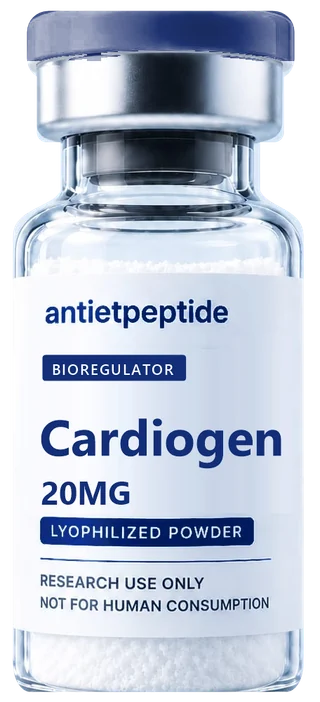
Cardiogen

Tetrapeptide bioregulator (Ala-Glu-Asp-Arg), 20 mg vials.

$131
Box of 10 vials · 20 mg each · Cat. No. CARD
Size
Volume pricing 5% off from $1,000, rising to 25% above $10,000. Applied automatically at checkout. Details →
1
Every batch tested and numbered
US warehouse delivery in 5 to 7 days
Sealed vials, 10 to a box
Factory-direct pricing

Research use only. Supplied for in vitro laboratory research. Not for human or veterinary use, and not a drug, food, cosmetic or supplement.
Cardiogen is a tetrapeptide, Ala-Glu-Asp-Arg, from the cardiac branch of the Khavinson bioregulator research.

It shares the Ala-Glu-Asp opening with Cartalax, Cortagen and Bronchogen, differing only in the fourth residue. That family resemblance is deliberate: the programme treated the terminal residue as the element conferring tissue specificity.

Research has examined it in cardiomyocyte and fibroblast cultures, looking at gene expression and protein synthesis. As with the rest of the family, the literature is modest and weighted toward Russian-language publications.

Supplied in 20 mg vials.

Selected research

  • Yuan Y (2020). Mechanisms Inspired Targeting Peptides. Adv Exp Med Biol. PubMed 32185724
  • Workman RJ (2024). Peptide diffusion in biomolecular condensates. Biophys J. PubMed 38751116
  • Abbas M (2021). Peptide-based coacervates as biomimetic protocells. Chem Soc Rev. PubMed 33616129
  • Drechsel H (1998). Peptide siderophores. J Pept Sci. PubMed 9643626
  • Zilker T (1977). [C-peptide secretion dependent on serum glucose and insulin secretion - autoregulation of insulin secretion]. Verh Dtsch Ges Inn Med. PubMed 347780
  • Glenn MP (2002). Mimetics of the peptide beta-strand. Mini Rev Med Chem. PubMed 12370045

All Antiet products are for laboratory research use only. They are not for human or veterinary use.

Sizes and prices

SizeCat. No.Price per box (10 vials)
20 mgCARD$131

Specifications

Product nameCardiogen
SequenceAla-Glu-Asp-Arg
Molecular formulaC18H31N7O9
Molecular weight489.5 g/mol
CAS number857267-11-9
Chain length4 amino acids
FormLyophilized powder in a sealed glass vial
PurityConfirmed per batch by HPLC, with identity by mass spectrometry
Packing10 vials per box
Storage-20 °C, dry and away from light

Every batch we make is tested before it ships. Analytical HPLC measures purity and mass spectrometry confirms the molecular identity, and the result is tied to the batch number printed on your box.

Testing is carried out by Janoshik Analytical and by partner laboratories in the United States and China.

Independent Janoshik reports for tested batches are published on our Certificates of Analysis page, each with a key you can verify on Janoshik's website. For a batch that isn't listed yet, email info@antietpeptide.com with the batch number on your box and our team will confirm it.

All lab reports →  ·  How we test every batch →

Supplied as lyophilized (freeze-dried) powder in a sealed glass vial with a flip-off cap and crimped collar.

  • Long-term: Store sealed vials at -20 °C, dry and away from light.
  • Short-term: 2 to 8 °C is adequate for a few weeks.
  • In transit: Lyophilized peptides are stable at room temperature for normal shipping times, so no cold pack is needed.
  • On opening: Let a cold vial reach room temperature before you break the seal, or condensation will settle on the powder. Avoid repeated freeze-thaw cycles.
Order preparation3 to 4 days. We pack and dispatch every other day.
US warehouse delivery5 to 7 days, $60
Express from China or Vietnam6 to 10 days, $90
Economy Line10 to 15 days, $60. Tracking appears on arrival in the destination country.
Extra shippingNone up to 25 boxes, then $20 per 10 extra boxes
PackagingSealed vials, 10 to a box, padded and protected
If a parcel is seized or lostFree reship or a full refund, your choice

Read our full Shipping Policy →

What is the sequence?

Ala-Glu-Asp-Arg, four residues, roughly 489 g/mol.

Why do several bioregulators start with Ala-Glu-Asp?

The programme varied the terminal residue to confer tissue specificity while keeping a common core.

Which tissue does it relate to?

Cardiac tissue, which is where the name originates.

What cell models has it been used in?

Cardiomyocyte and fibroblast cultures, with gene expression as a typical readout.

Is the vial under vacuum?

Lyophilized vials are sealed after drying. Release pressure slowly when first entering one.

More in Bioregulator Peptides

View category →
Cardiogen