Proteins and Signaling Molecules

Follistatin

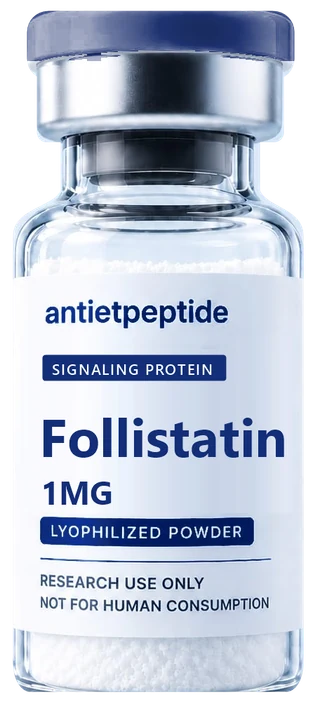
Activin- and myostatin-binding glycoprotein, 1 mg vials.

$363
Box of 10 vials · 1 mg each · Cat. No. FN1
Size
Volume pricing 5% off from $1,000, rising to 25% above $10,000. Applied automatically at checkout. Details →
1
Every batch tested and numbered
US warehouse delivery in 5 to 7 days
Sealed vials, 10 to a box
Factory-direct pricing

Research use only. Supplied for in vitro laboratory research. Not for human or veterinary use, and not a drug, food, cosmetic or supplement.

Follistatin is a glycoprotein that binds and neutralises members of the TGF-beta superfamily, principally activin and myostatin. It does not act through a receptor of its own. It works by sequestering ligands before they reach theirs.

That mechanism makes it a natural antagonist, which is unusual among the proteins in this category. Its binding is close to irreversible, which is why small amounts have substantial effects in culture.

Research uses it in myoblast and myotube cultures where myostatin signalling is measured, in activin signalling assays, and in rodent muscle studies. It is a standard reagent wherever TGF-beta family ligands need to be neutralised.

GDF-8, the myostatin it binds, is stocked here as the matching ligand.

Selected research

  • Vestal KA (2024). Activin E is a transforming growth factor β ligand that signals specifically through activin receptor-like kinase 7. Biochem J. PubMed 38533769
  • Bowser M (2013). Effects of the activin A-myostatin-follistatin system on aging bone and muscle progenitor cells. Exp Gerontol. PubMed 23178301
  • Saitoh M (2020). Discovery of a follistatin-derived myostatin inhibitory peptide. Bioorg Med Chem Lett. PubMed 31874826
  • Kocamis H (1999). The ontogeny of myostatin, follistatin and activin-B mRNA expression during chicken embryonic development. Growth Dev Aging. PubMed 10892562
  • Cash JN (2012). Characterization of follistatin-type domains and their contribution to myostatin and activin A antagonism. Mol Endocrinol. PubMed 22593183
  • Sidis Y (2006). Biological activity of follistatin isoforms and follistatin-like-3 is dependent on differential cell surface binding and specificity for activin, myostatin, and bone morphogenetic proteins. Endocrinology. PubMed 16627583

All Antiet products are for laboratory research use only. They are not for human or veterinary use.
Sizes and prices

SizeCat. No.Price per box (10 vials)
1 mgFN1$363

Specifications

Product nameFollistatin
Chain length315 amino acids
FormLyophilized powder in a sealed glass vial
PurityConfirmed per batch by HPLC, with identity by mass spectrometry
Packing10 vials per box
Storage-20 °C or colder, dry and away from light

Every batch we make is tested before it ships. Analytical HPLC measures purity and mass spectrometry confirms the molecular identity, and the result is tied to the batch number printed on your box.

Testing is carried out by Janoshik Analytical and by partner laboratories in the United States and China.

Independent Janoshik reports for tested batches are published on our Certificates of Analysis page, each with a key you can verify on Janoshik's website. For a batch that isn't listed yet, email info@antietpeptide.com with the batch number on your box and our team will confirm it.

All lab reports →  ·  How we test every batch →

Larger proteins are less forgiving than short peptides.

  • Long-term: Store at -20 °C or colder, dry and away from light.
  • Short-term: 2 to 8 °C.
  • Handling: Avoid repeated freeze-thaw cycles and vigorous shaking, both of which denature protein. Aliquot before freezing where your protocol allows.
Order preparation3 to 4 days. We pack and dispatch every other day.
US warehouse delivery5 to 7 days, $60
Express from China or Vietnam6 to 10 days, $90
Economy Line10 to 15 days, $60. Tracking appears on arrival in the destination country.
Extra shippingNone up to 25 boxes, then $20 per 10 extra boxes
PackagingSealed vials, 10 to a box, padded and protected
If a parcel is seized or lostFree reship or a full refund, your choice

Read our full Shipping Policy →

How does follistatin work?

It binds and sequesters TGF-beta family ligands such as activin and myostatin, preventing them reaching their receptors.

Does it have its own receptor?

No. It acts by binding ligands directly, which makes it an antagonist by sequestration.

What is the difference between follistatin and FST-344?

FST-344 is the longer precursor isoform. The follistatin commonly supplied is the shorter processed form.

Which ligands does it bind most strongly?

Activin and myostatin, both TGF-beta superfamily members.

What happens if a vial arrives with a broken seal?

Email us within a week with your order number and a photo. If the fault is ours you get a replacement or refund.

More in Proteins and Signaling Molecules

View category →
Follistatin