Mitochondrial and Metabolic Research

L-Carnitine

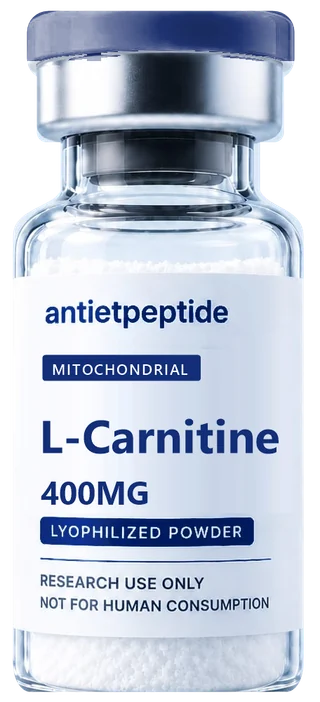
Amino acid derivative involved in fatty acid transport, 400 mg and 600 mg.

$60
Box of 10 vials · 400 mg each · Cat. No. LC4
Size
Volume pricing 5% off from $1,000, rising to 25% above $10,000. Applied automatically at checkout. Details →
1
Every batch tested and numbered
US warehouse delivery in 5 to 7 days
Sealed vials, 10 to a box
Factory-direct pricing

Research use only. Supplied for in vitro laboratory research. Not for human or veterinary use, and not a drug, food, cosmetic or supplement.

L-carnitine is a small amino acid derivative that carries long-chain fatty acids across the inner mitochondrial membrane, a step fatty acids cannot complete on their own.

The mechanism is a shuttle. Carnitine palmitoyltransferase attaches a fatty acid to carnitine on one side of the membrane, a translocase moves the pair across, and a second enzyme releases the fatty acid inside. Without it, long-chain fatty acids never reach the enzymes that break them down.

That makes it a standard reagent in fatty acid oxidation research, used in hepatocyte and myotube cultures and in rodent metabolic studies. Measuring acylcarnitine species is also a common way to read out oxidation flux.

Note that only the L form is biologically active; the D form is not.

Selected research

  • Choi J (2024). Carnitine palmitoyltransferase 1 facilitates fatty acid oxidation in a non-cell-autonomous manner. Cell Rep. PubMed 39671290
  • Schönfeld P (2016). Short- and medium-chain fatty acids in energy metabolism: the cellular perspective. J Lipid Res. PubMed 27080715
  • Zhang T (2024). Crystal structure combined with metabolomics and biochemical studies indicates that FAM3A participates in fatty acid beta-oxidation upon binding of acyl-L-carnitine. Biochem Biophys Res Commun. PubMed 39111121
  • Turkaly P (1999). A 22 kDa polyanion inhibits carnitine-dependent fatty acid oxidation in rat liver mitochondria. FEBS Lett. PubMed 10544243
  • Cardoso LHD (2025). Fatty acid β-oxidation in brain mitochondria: Insights from high-resolution respirometry in mouse, rat and Drosophila brain, ischemia and aging models. Biochim Biophys Acta Mol Basis Dis. PubMed 39424161

All Antiet products are for laboratory research use only. They are not for human or veterinary use.
Sizes and prices

SizeCat. No.Price per box (10 vials)
400 mgLC4$60
600 mgLC6$68

Specifications

Product nameL-Carnitine
Molecular formulaC7H15NO3
Molecular weight161.20 g/mol
CAS number541-15-1
FormLyophilized powder in a sealed glass vial
PurityConfirmed per batch by HPLC, with identity by mass spectrometry
Packing10 vials per box
Storage-20 °C, dry and away from light

Every batch we make is tested before it ships. Analytical HPLC measures purity and mass spectrometry confirms the molecular identity, and the result is tied to the batch number printed on your box.

Testing is carried out by Janoshik Analytical and by partner laboratories in the United States and China.

Independent Janoshik reports for tested batches are published on our Certificates of Analysis page, each with a key you can verify on Janoshik's website. For a batch that isn't listed yet, email info@antietpeptide.com with the batch number on your box and our team will confirm it.

All lab reports →  ·  How we test every batch →

Supplied as lyophilized (freeze-dried) powder in a sealed glass vial with a flip-off cap and crimped collar.

  • Long-term: Store sealed vials at -20 °C, dry and away from light.
  • Short-term: 2 to 8 °C is adequate for a few weeks.
  • In transit: Lyophilized peptides are stable at room temperature for normal shipping times, so no cold pack is needed.
  • On opening: Let a cold vial reach room temperature before you break the seal, or condensation will settle on the powder. Avoid repeated freeze-thaw cycles.
Order preparation3 to 4 days. We pack and dispatch every other day.
US warehouse delivery5 to 7 days, $60
Express from China or Vietnam6 to 10 days, $90
Economy Line10 to 15 days, $60. Tracking appears on arrival in the destination country.
Extra shippingNone up to 25 boxes, then $20 per 10 extra boxes
PackagingSealed vials, 10 to a box, padded and protected
If a parcel is seized or lostFree reship or a full refund, your choice

Read our full Shipping Policy →

What does L-carnitine do?

It carries long-chain fatty acids into mitochondria, where they can be oxidised.

Why can't fatty acids cross on their own?

Long-chain fatty acids cannot pass the inner mitochondrial membrane unaided. The carnitine shuttle is the transport mechanism.

Why specify the L form?

Only L-carnitine is biologically active. The D enantiomer is not and can interfere.

What are acylcarnitines?

Fatty acids bound to carnitine. Measuring them is a common way to assess oxidation flux.

How is it supplied?

As lyophilized powder in a sealed glass vial with a flip-off cap and crimped collar, ten vials to a box.

More in Mitochondrial and Metabolic Research

View category →
L-Carnitine