A certificate of analysis is only worth something if you can read it and verify it. If you buy research peptides, you have seen plenty of them: a page of numbers, a lab logo, a purity figure in the high nineties. The hard part is working out what those numbers actually say about the vial in your hand, and whether the document came from a laboratory at all.
The stakes have risen. On 7 November 2026, a spokesperson for the testing lab Janoshik Analytical told ABC News that the company receives up to five reports a day where “a test document has been altered or incorrectly used by a business that did not commission it.”
This guide reads a peptide COA line by line, using six real reports you can open and check yourself.
Quick answer
To read a peptide COA, check five things: the compound and batch number match your vial, an independent lab is named, the amount and purity results are listed, identity was confirmed, and the report can be verified directly with the lab that issued it.
What Is a Peptide Certificate of Analysis?
A COA is a lab report on one production batch of a peptide. It records what a laboratory measured in a sample it received, on a date, using a stated method. Everything it tells you is tied to that batch and that sample.
Each report covers a single production run in a single size. A 10 mg vial and a 5 mg vial of the same peptide come from separate runs with separate numbers, so each one needs its own report.
Three kinds of organizations issue them: the supplier, the manufacturer, or an independent laboratory signing the result in its own name. Only the third can be checked without taking somebody’s word for it.
Grade changes what the document promises. A research COA reports what was measured. A GMP certificate comes out of a quality system with audited procedures, validated methods, and release criteria behind it, a far larger claim and a far more expensive one.
The same document goes by several names: COA, CoA, certificate of analysis, lab report, or test report. They all mean the page of results.
Every Section of a COA at a Glance
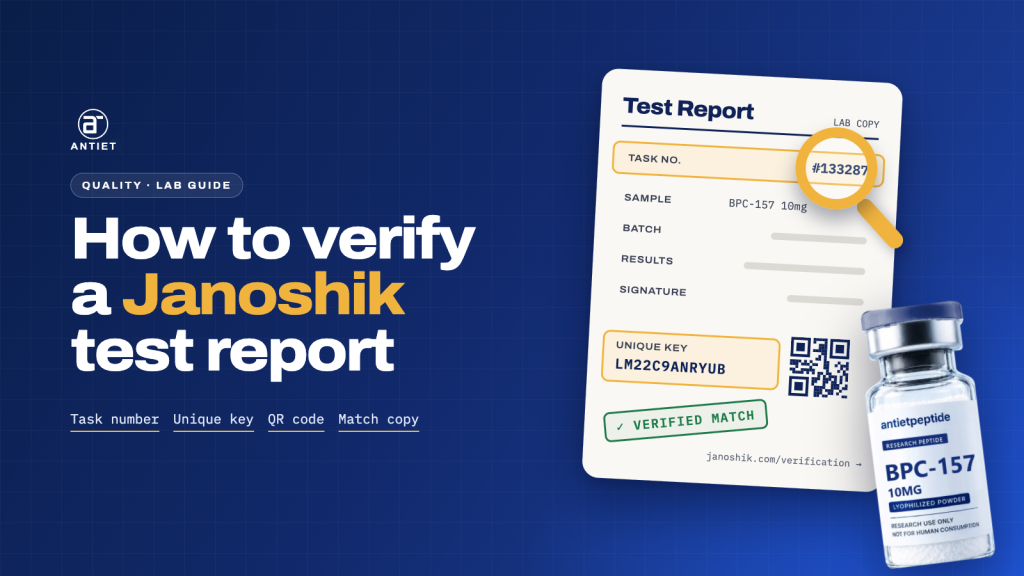
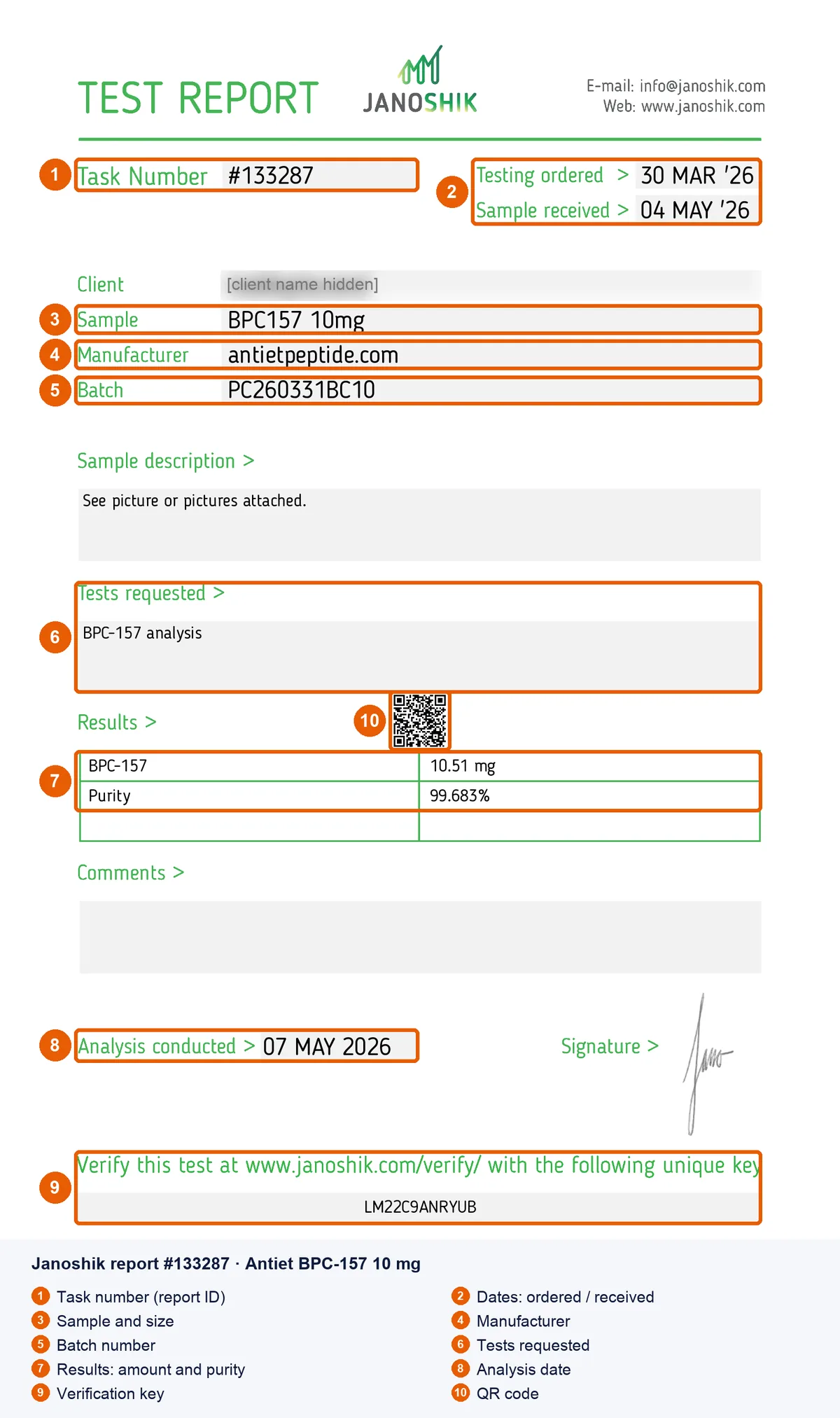
Most peptide COAs have the same six to eight parts, whatever the lab. Once you know which part answers which question, a report takes about ninety seconds to read. The table maps each section against Janoshik report #133287, covering an Antiet BPC-157 10 mg batch.
| Section | What it shows | What it proves | What it doesn’t prove | Example from #133287 |
|---|---|---|---|---|
| Report ID/task number | The lab’s reference for the job | The report exists in the lab’s system | Nothing about the sample itself | #133287 |
| Sample and size | What the lab was given | Which product the result belongs to | That every size was tested | BPC157 10mg |
| Manufacturer/client | Who the material is from, and who ordered the test | Who stands behind the sample | Where your vial was filled | antietpeptide.com |
| Batch | The production run | Which run the result covers | That other runs match | PC260331BC10 |
| Dates | Ordered, received and analysed | How current the result is | Anything about storage since | Received 4 May 2026, analysed 7 May 2026 |
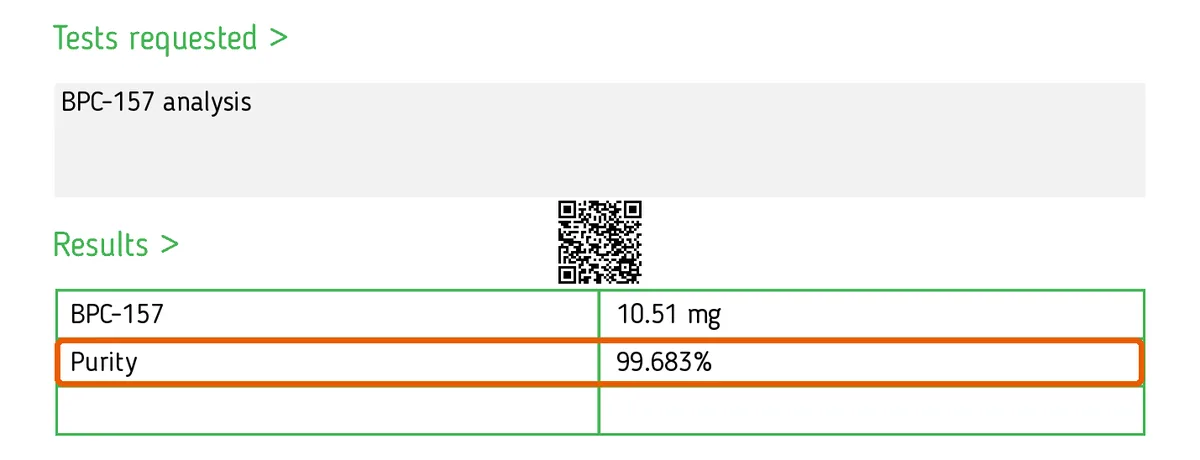
| Tests requested | What the lab was paid to look for | The scope of the whole report | That anything else was checked | BPC-157 analysis |
| Results: amount | How much target compound was measured | The quantity in that vial | The weight of the powder | 10.51 mg |
| Results: purity | How clean the peptide content is | Degradation and related impurities | The quantity, or the identity | 99.683% |
| Extra panels | Endotoxin, metals, water, sterility | Only the panels listed | Anything not ordered | None on this report |
| Signature and verification key | The lab’s sign-off and check code | That the report can be traced back | That the batch number is yours | LM22C9ANRYUB |
Read the “tests requested” line before the results. A COA answers only the question somebody paid a laboratory to ask, and that line sets the scope of everything below it.
How to Read a Peptide COA, Step by Step
Each step follows the same shape: what to look for, what good looks like, and the red flag.
Step 1: Check the compound name and size
The sample name and size should match the product exactly. On report #133283 the sample reads “retatrutide 20mg”, which lines up with a 20 mg vial.
Labs use shorthand, so a name can look wrong at first. Report #133286 reads “GHKCU 100mg”, and report #133288 reads “TSM20” for Tesamorelin at 20 mg. The tests-requested line settles it: #133288 says “Tesamorelin analysis”. A CAS number or full sequence, where a report carries one, removes the doubt entirely.
Red flag: A sample name so generic it could describe anything, with no tests-requested line to pin it down.
Step 2: Match the batch number and test date to your vial
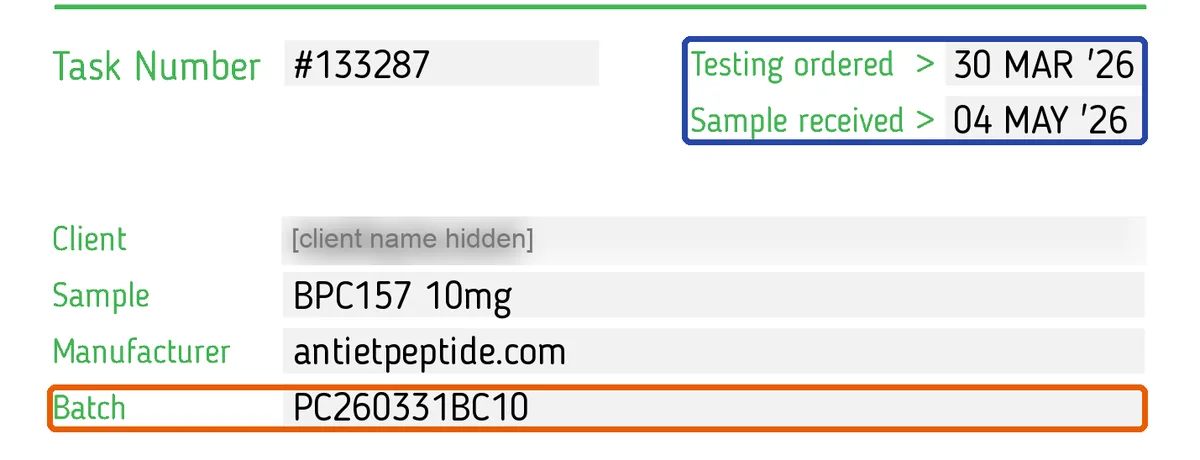
A COA only describes your vial if the batch numbers match. Report #133287 covers batch PC260331BC10, and that string should appear on the box your vials came in. A report for a different batch describes different material, however good the numbers look.
Janoshik reports carry three dates: testing ordered, sample received, analysis conducted. The analysis date is the one to read. On #133287 the sample arrived on 4 May 2026 and was analysed on 7 May 2026.
No published rule sets how recent a report has to be, and a fixed number of months is a convention someone has adopted. The reasoning is simple enough to apply yourself: peptides degrade over time, which is what a purity figure measures, so a result describes the batch as it was on the analysis date.
Red flag: A batch number that doesn’t appear on your box. Ask the supplier for the report covering your batch.
Step 3: Find out who did the testing
The most important line on a COA is the lab’s name. In-house testing means the seller checked its own work, manufacturer testing means the producer did, and third-party testing means an outside laboratory measured the sample and signed off. Only the third can be audited by a buyer.
Two header fields on a third-party report describe different parties. “Client” is whoever commissioned the test. “Manufacturer” is whose product the material is. Antiet’s six reports show Manufacturer: antietpeptide.com, tying the sample to the producer.
Accreditation is a separate question from independence, and the two get muddled. ISO/IEC 17025:2017 is the international standard for the competence of testing laboratories. Look for the claim rather than a logo. A laboratory holding the accreditation names the body that granted it and the scope it covers, since scope runs method by method. Plenty of research-peptide labs make no such claim anywhere on their sites, which leaves you relying on independence alone, worth knowing rather than assuming. Where a claim is made, the ILAC signatory directory lists accreditation bodies by economy, and each body publishes its own register of assessed laboratories.
Red flag: A purity figure with no laboratory named, or a logo with no report number behind it.
Step 4: Read the purity result (HPLC)
Purity tells you how much of the peptide material is the target peptide. The standard method is high-performance liquid chromatography, or HPLC, which pushes the dissolved sample through a column so its components emerge separated by time, then measures what passes a UV detector.
The output is a chromatogram: a baseline with peaks rising from it. The target peptide gives one tall peak at a characteristic retention time, and everything else gives smaller peaks or shoulders beside it. Purity is the main peak’s share of the total peak area, which is why you’ll hear it called area percent.
Two details decide what that percentage means. The first is what it’s a percentage of. Janoshik’s help centre defines its peptide purity figure as a share of the peptide content, explaining that “it shows how much of the peptide content consists of the pure target peptide molecule. The remaining peptide content consists of degradation products.” Its m/m figure, used for raw API powders, measures the share of the whole powder instead. The second is that the lab does not report peptide purity at all for blends or capsules, because the components interfere with the measurement, so a single purity number on a blend is a number to question.
Across Antiet’s six reports, the figures run from 97.258% on HGH to 99.683% on BPC-157. A benchmark of 98% or better is common across research-peptide suppliers, set by buyers, carrying no legal force.
Some laboratories publish the final figure and keep the underlying chromatogram, which is reasonable when the report itself can be verified. Janoshik sells the raw data as a $25 add-on, so the trace can be bought with the analysis.
Red flag: A purity figure with no method named, or a precise-looking percentage on a product the method can’t measure.
Step 5: Confirm identity (mass spectrometry)
Purity says how clean the sample is. Identity says what it is. A sample can be beautifully clean and still be the wrong molecule, which makes identity the question to settle first. It is the question peptide forums keep circling: the most-answered thread on reading a COA ran to 41 replies, and two more in autumn 2026 asked about purity versus identity.
Mass spectrometry is the usual tool. The instrument ionises the sample and measures the mass-to-charge ratio of what comes out, so the observed molecular weight can be set against the weight calculated from the sequence. Peptides show up in several charge states, written as [M+2H]²⁺ and so on, and the observed and expected figures should agree closely.
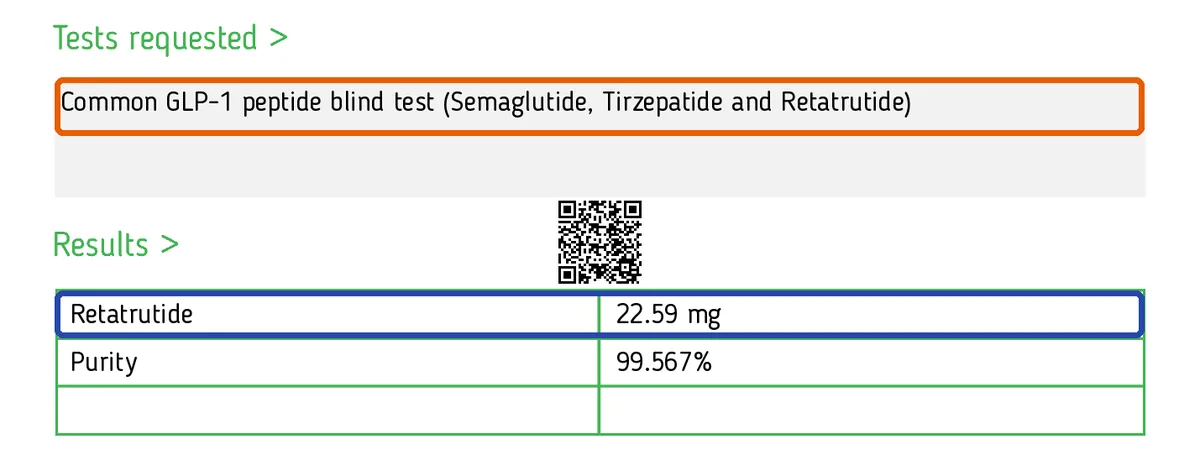
Identity can also be established by running the sample blind. Report #133283 was handled as a “Common GLP-1 peptide blind test (Semaglutide, Tirzepatide and Retatrutide)”, and the laboratory describes the method plainly: “With blind testing, you do not need to tell us which of the three peptides you suspect to be in your vial. The test will identify the peptide.” The report came back naming retatrutide. The lab was not told what to look for and found it anyway, which is a stronger result than a test that only confirms what it was handed.
The risk is documented. Researchers at Ghent University bought 98 synthetic peptides and checked them, reporting in the Journal of Pharmaceutical Analysis that “the main compound of one sample was even found to have a different structure compared to the desired peptide.”
Red flag: A purity percentage with nothing on the page establishing what the compound is.
Step 6: Don’t confuse purity with the amount in the vial
A vial can be 99% pure and still not contain the amount on the label, so check both numbers. Purity is a proportion, amount is a quantity, and they come from different measurements.
| Report | Label | Lab result | What it shows |
|---|---|---|---|
| #133287 BPC-157 | 10 mg | 10.51 mg · 99.683% | Amount and purity both line up with the label |
| #133283 Retatrutide | 20 mg | 22.59 mg · 99.567% | The amount can differ from the label and is reported separately |
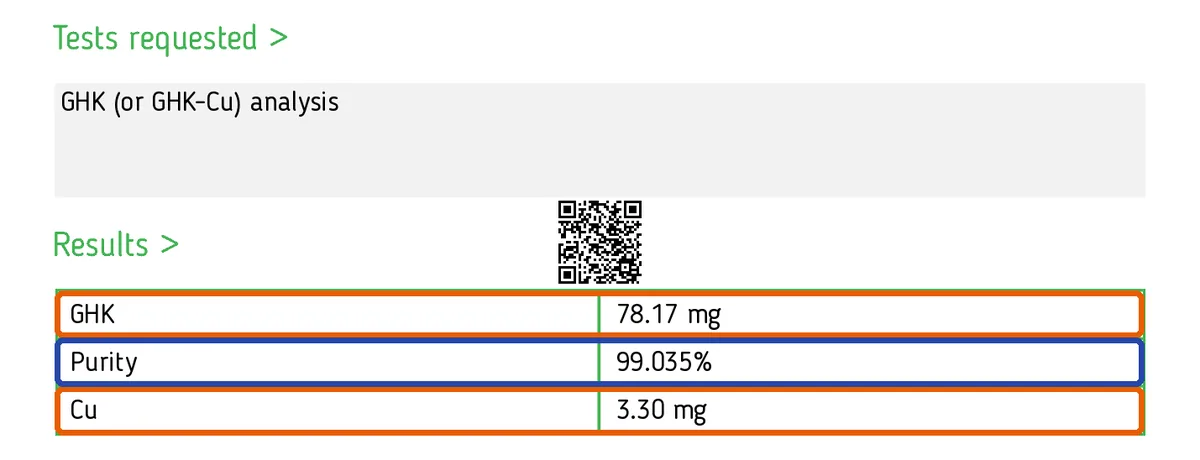
| #133286 GHK-Cu | 100 mg | GHK 78.17 mg + Cu 3.30 mg · 99.035% | A copper complex is reported as peptide and copper separately, so neither figure equals the label weight |
| #133284 HGH | 24 IU | 8.99 mg / 26.97 IU · 97.258% | Some proteins are measured in international units as well as milligrams |
The GHK-Cu row rewards a pause. GHK is the tripeptide glycine-histidine-lysine, 340 g/mol, and GHK-Cu is that tripeptide bound to one copper atom at 403.5 g/mol, so copper accounts for roughly a sixth of the complex by weight. The laboratory reports peptide and copper on their own lines, and the purity figure refers to the peptide.
A third number rarely reaches a research COA at all. Net peptide content is the share of the powder’s weight that is peptide, with water and the counter-ions left from purification making up the rest, usually trifluoroacetic acid or acetate. Bachem’s quality control guide makes usable peptide the gross weight multiplied by purity multiplied by content, and its example of bradykinin acetate at 98.7% purity and 85.0% content puts real distance between the two percentages.
Janoshik settles this for its own reports: “The mg value on your report shows the measured amount of the tested substance, not the total weight of the sample.” TFA analysis, if you want the counter-ion figure, is a separate $290 test.
Red flag: A label weight presented as a measured result, with no amount reported by the lab.
Step 7: Look for extra test panels
Purity and amount are standard; everything else is an extra test that must be ordered separately. Each panel is a separate purchase with its own price, which is why most research COAs carry two results and nothing more.
Endotoxin testing is the clearest example. Report #133285 covers HGH batch PC260331HG24 and returns one line: Endotoxin 3.641 EU/vial. An endotoxin unit measures endotoxin activity, determined by the LAL assay against a reference standard. FDA guidance revised in March 2026 points to US Pharmacopeia Chapter <85>, the Bacterial Endotoxins Test, for the method behind it. Janoshik’s standard reporting range runs from 1 to 1000 EU per vial, and the test needs its own vial, which is why #133285 carries a separate task number from #133284.
Other panels include heavy metals by ICP-MS, water content by Karl Fischer titration, residual solvents, bioburden or sterility, and an appearance check. Each describes the quality of the material and says nothing about its suitability for any purpose.
Red flag: A report that gestures at “full panel testing” without naming the panels or showing their results.
How to Check a COA Is Real
A real COA can be traced back to the lab that issued it. With a Janoshik report, the check takes under a minute, using the document itself.
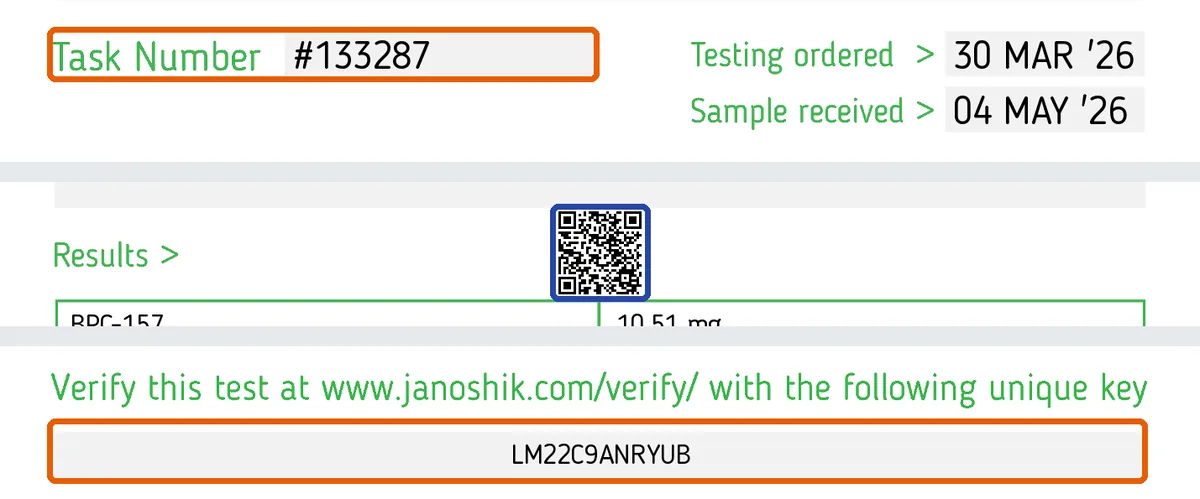
- Find the two identifiers: The task number prints at the top of the report, and the unique key at the bottom. On #133287 those are 133287 and LM22C9ANRYUB.
- Open the lab’s verification page: Go to janoshik.com/verification, where the Verify link in the lab’s own menu points. The QR code on the report goes to the same place.
- Enter both identifiers: Type the task number and the key, in capitals, then submit.
- Read the response: A report in the database returns “This test is in our database. You can open the report and check if the data match your report.”
- Compare the two documents: Open the lab’s stored copy and read it against the PDF you were sent, checking the sample name, the batch, the dates, and every result.
Step five is the one people skip, and it does the real work. Janoshik is blunt about why: “A report is considered legitimate only if it matches the version stored in our system.” The lab also notes that if either identifier is missing, the report cannot be verified at all.
The ABC investigation found exactly that pattern in November 2026, where “report numbers had been removed or hidden, and on at least one report, the report named a completely different business, which had commissioned the test.” Anyone with a questionable document should “verify it directly with the laboratory,” the lab advises, because a report that cannot be verified “has likely been issued for a different company.”
Mismatched fonts, values nudged off their baseline, and a cropped footer all deserve the same second look.
Red Flags of a Fake or Weak COA
Most fake COAs fail one of a few simple checks, none of which needs any analytical knowledge.
| Red flag | Why it counts |
|---|---|
| No lab named, or only a logo | There is nothing to verify the document against |
| A generic “sample” COA | The result describes a demonstration batch |
| Batch number absent from your box | The report covers different material |
| Purity only, from an unnamed lab, with no way to check it | That is a claim with nothing behind it |
| No identity confirmation anywhere on the page | A purity figure with no answer to “purity of what” |
| The same report used for every batch and every size | One report covers one batch and one size |
| No report ID, key or QR code | The lab cannot confirm the document |
| A single purity figure on a blend | The method cannot measure it reliably |
| Signs of editing | Removed numbers and altered values are the most reported problem in the trade |
Professor Bart De Spiegeleer, who heads the Drug Quality and Registration laboratory at Ghent University, published the sharpest evidence for reading a COA this way. His group ordered 98 peptides at a requested purity of at least 95%, and all of them arrived with paperwork to match: “all the 98 peptides were accompanied by a certificate of analysis stating at least 95.0% purity.” On testing, “only 43 out of 98 peptides met these purity specifications.” His team concluded that “relying on the certificates of analysis as provided by the supplier might have serious consequences for peptide research.”
What a COA Can’t Tell You
A COA describes one batch, tested in a lab, on one date. Reading it well means knowing where its authority stops.
It carries no finding on human safety, no judgement of fitness for any use, and no regulatory approval. It covers the batch and size named on it, so a report on a 10 mg vial says nothing about the 5 mg run. It also describes the sample as it was on the analysis date, leaving everything that happened in transit and storage outside its scope.
How Antiet Tests Its Batches
Antiet’s batches are tested by Janoshik Analytical, and each report can be verified on Janoshik’s site. The five below cover the March 2026 production runs, and every one opens in your browser.
| Product | Size tested | Janoshik # | Purity | Product page |
|---|---|---|---|---|
| Retatrutide | 20 mg | 133283 | 99.567% | Retatrutide |
| HGH (Somatropin) | 24 IU | 133284, plus endotoxin 133285 | 97.258% | HGH (Somatropin) |
| GHK-Cu | 100 mg | 133286 | 99.035% | GHK-Cu |
| BPC-157 | 10 mg | 133287 | 99.683% | BPC-157 |
| Tesamorelin | 20 mg | 133288 | 98.658% | Tesamorelin |
Each report covers one batch and one size, the limit that applies to every COA in this guide. Every Antiet batch goes through the same testing and COA routine before release, and the rest of the research peptide catalogue carries batch numbers on that basis.
For a product or size not listed above, email info@antietpeptide.com with the batch number from your box and we’ll confirm its testing status within 48 hours.
Frequently Asked Questions
What does a peptide COA look like?
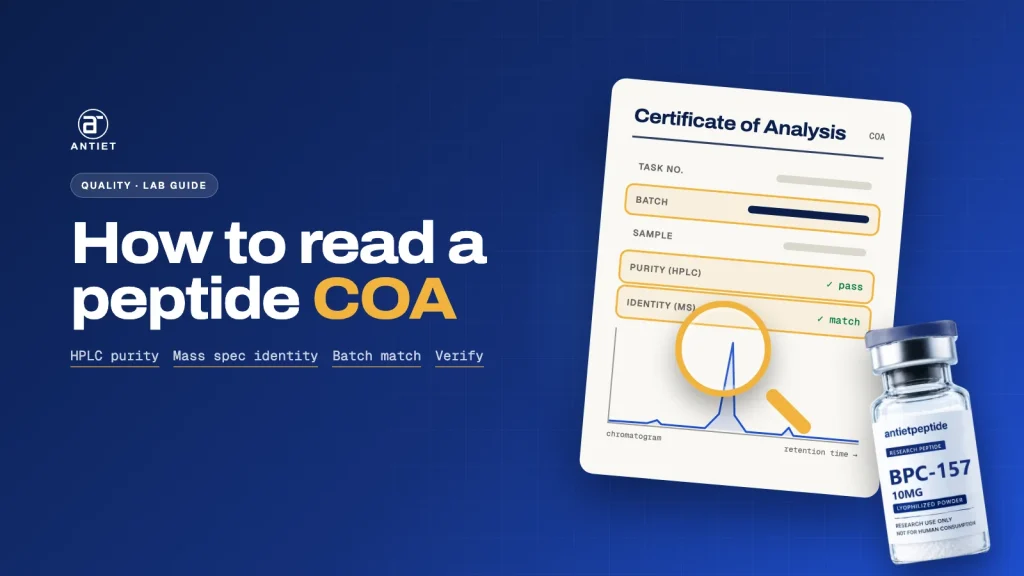
Usually one or two pages: a header with the lab’s name and a report number, then the sample, batch, and manufacturer, then the dates, a results table, and a signature with a verification key or QR code. The annotated report at the top of this guide shows each part in place.
How do I tell if a peptide COA is legit?
Check that an independent laboratory is named, that the report carries an ID and a verification key, and that the batch matches your box. Then verify it on the lab’s site and read the stored copy against the one you were sent.
How do I get a certificate of analysis from a peptide provider?
Ask for the report covering the batch number printed on your box. A supplier that tests properly can tie one report to one run. A generic PDF with no batch on it is itself an answer.
How much does peptide purity testing cost?
Janoshik’s published prices run from $215 for a BPC-157 analysis to $290 for GHK-Cu or tesamorelin and $360 for an HGH or blind GLP-1 test, with endotoxin at $180. Other laboratories price differently, so ask for a quote.
What purity should a research peptide COA show?
98% or better is the common benchmark among research-peptide suppliers, set by buyers rather than any regulator. Read it alongside the amount in the vial and the evidence of identity, because a percentage on its own settles one question out of three.
What is the difference between HPLC purity and net peptide content?
Purity is the share of the peptide material that is intact target peptide. Net peptide content is the share of the total powder weight that is peptide, with water and counter-ions making up the rest. Report #133286 shows the principle: GHK 78.17 mg and copper 3.30 mg, both reported separately from the 100 mg label.
Does a COA show a peptide is safe for human use?
No. A COA is analytical data on one batch of research material, measured on one date. All Antiet products are supplied for laboratory research use only.
All Antiet products are for laboratory research use only. Not for human or veterinary use. Antiet’s Terms of Sale carry the full terms.
This article is for general laboratory information only. Antiet products are sold strictly for research use and are not for human or veterinary use.