Two vials can carry the same name on the label and behave nothing alike in a study model. CJC-1295 is a synthetic copy of the first 29 amino acids of growth hormone-releasing hormone, and it exists in two versions. The difference between them is one small chemical attachment called DAC, which pins the peptide to a blood protein and stretches its measured half-life from minutes to days.
Quick answer: CJC-1295 with DAC carries a Drug Affinity Complex that bonds covalently to serum albumin, extending its half-life to 5.8 to 8.1 days in human trials. CJC-1295 without DAC, also sold as Mod GRF 1-29, lacks that attachment and clears far faster. Sermorelin is unmodified GRF(1-29), with a plasma half-life of 6 to 7 minutes. All three are research-use-only compounds.
Research use only. The compounds described here are laboratory materials supplied under Antiet’s Terms of Sale, and nothing on this page describes human or veterinary use.
What Is CJC-1295?
CJC-1295 is a synthetic analog of GHRH(1-29), the active fragment of human growth hormone-releasing hormone, altered at four amino-acid positions so enzymes in blood break it down more slowly. GHRH is the signal the brain sends to the pituitary gland to release growth hormone, and the first 29 amino acids of it carry almost all of that signalling power.
The four swaps are at positions 2, 8, 15 and 27, and they slow down one enzyme in particular: dipeptidyl peptidase IV, or DPP-IV, which clips the front end off the natural peptide within minutes. Jetté and colleagues reported in Endocrinology that their albumin conjugates “showed enhanced in vitro stability against dipeptidyl peptidase-IV” and stayed active in a growth hormone secretion assay using cultured rat pituitary cells.
The compound came out of ConjuChem, a Montreal biotech, in the early 2000s. CJC-1295 was the lead candidate from a set of three, and the same paper recorded a four-fold rise in growth hormone area under the curve over two hours against plain hGRF(1-29) in rats.
Mechanistically, it does what GHRH does, binding the GHRH receptor on the pituitary. That is why research interest stays almost entirely on the growth hormone and IGF-1 axis.
CJC-1295 has never been approved by the FDA for any use, in any country, in either form. It is a research compound, and Antiet lists it alongside the other GHRH analogs available for research on that basis.
What Does DAC Mean in CJC-1295?
DAC in CJC-1295 stands for Drug Affinity Complex, a reactive chemical group attached to the peptide that forms a permanent covalent bond with serum albumin once the compound reaches circulation in a study model. That single addition is the whole difference between the two forms sold under the CJC-1295 name.
Chemically, the group is a maleimide. Jetté’s team identified their lead compound as “a tetrasubstituted form of hGRF(1-29) with an added N epsilon-3-maleimidopropionamide derivative of lysine at the C terminus.” In plainer terms: an extra lysine was hung off the tail of the 29-amino-acid chain, and a maleimidopropionic acid group was fixed to that lysine.
Maleimides are picky. They react with free thiol groups, and albumin happens to carry one at cysteine-34. ConjuChem’s own DAC technology page explains why the reaction lands there and almost nowhere else: albumin’s thiol has “a more reactive thiol group (pK ~5.0)” against cysteine at roughly 8.5 and glutathione at roughly 8.9. The company also states flatly that “the covalent attachment of a DAC to albumin is permanent.”
How Albumin Binding Changes Clearance
Think of albumin as a bus the peptide gets welded to. On its own, a 3,400-dalton peptide is small enough for the kidneys to filter out and exposed enough for enzymes to chew through. Welded to a protein that ConjuChem puts at “around 15 days in humans,” it runs on the bus timetable.
Jetté’s team watched that happen in rats. Their Western blot found CJC-1295 immunoreactivity sitting on the albumin band, “appearing after 15 min and remaining in circulation beyond 24 h,” with the compound detectable in plasma past 72 hours.
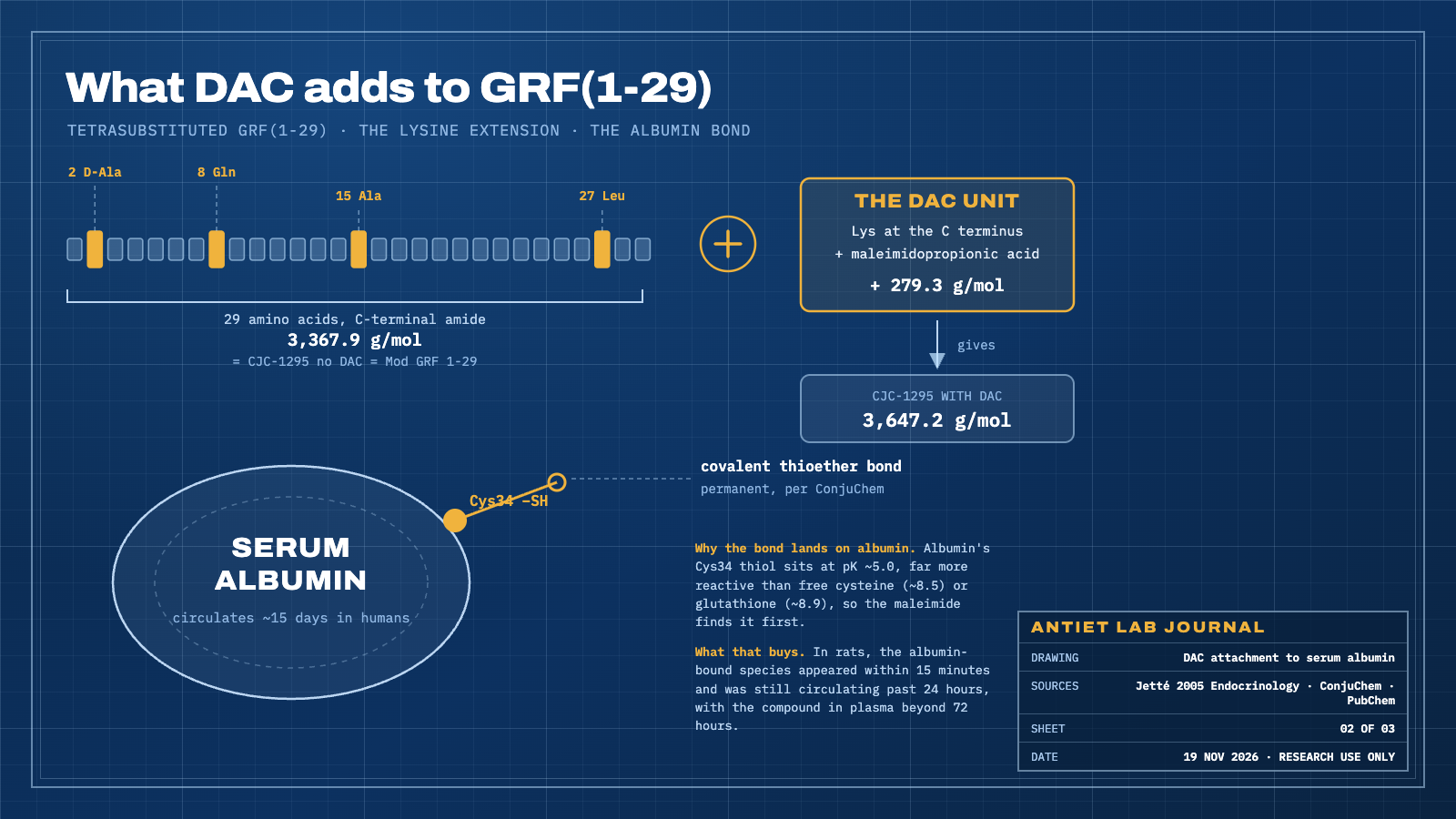
Drug Affinity Complex binding CJC-1295 to serum albumin
CJC-1295 Without DAC = Mod GRF 1-29
“CJC-1295 without DAC” and “Mod GRF 1-29” are two names for one peptide: the tetrasubstituted GRF(1-29) sequence with no Drug Affinity Complex attached. Same 29 amino acids, same four substitutions, same C-terminal amide, and none of the albumin chemistry above.
The naming came about backwards. “Tetrasubstituted GRF(1-29)” is what the 2005 literature called the bare peptide, and “CJC-1295” was ConjuChem’s development code for the albumin conjugate built from it. Suppliers later began selling the bare peptide under the better-known code with “no DAC” tacked on, and both names now circulate for the same material. Bill Roberts, a medicinal chemist writing for MESO-Rx, puts it bluntly: “This is a confusing misnomer.”
The confusion is not academic. Even PubChem’s entry for the 29-residue peptide, CID 56841945, carries both “CJC 1295 with DAC” and “CJC-1295-no DAC acetate” in its synonym list. The sequence on the record settles it, since it ends in argininamide at residue 29 with no lysine extension, but a buyer skimming names would come away none the wiser.
One question comes up again and again in peptide forums and vendor threads: which of the two molecules is actually in the vial, and what on the paperwork settles it. The mass answers it in one line, because the two forms differ by roughly 279 daltons.
In research, the practical consequence is timing. The no-DAC peptide produces short bursts of growth hormone release in study models, while the DAC form keeps growth hormone raised for days. Antiet lists the two forms separately, so the label names which peptide is in the vial: CJC-1295 no DAC for the short-acting one and CJC-1295 with DAC for the albumin-bound one.
CJC-1295 With DAC vs Without DAC vs Sermorelin: Side by Side
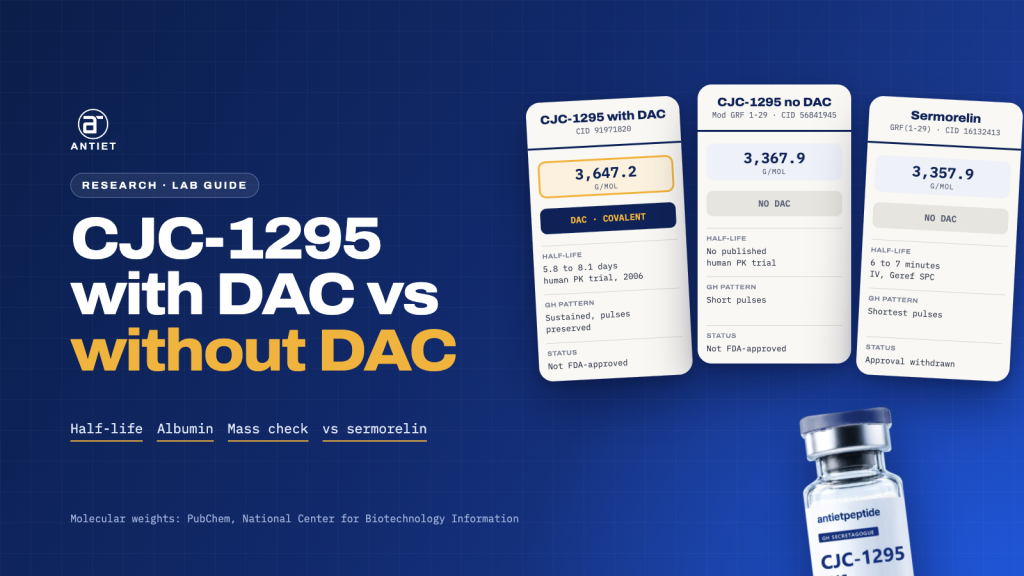
| Field | CJC-1295 with DAC | CJC-1295 no DAC (Mod GRF 1-29) | Sermorelin |
|---|---|---|---|
| Base structure | GRF(1-29) + 4 substitutions + DAC on a C-terminal lysine | GRF(1-29) + 4 substitutions | GRF(1-29), unmodified |
| Albumin binding | Yes, covalent, at cysteine-34 | No | No |
| Half-life in studies | 5.8 to 8.1 days (human PK trial, Teichman 2006) | No published human PK trial | 6 to 7 minutes after IV dosing (Geref SPC) |
| GH release pattern in studies | Sustained GH and IGF-1 elevation, pulsatility preserved | Short pulses | Short pulses, shortest duration |
| Development history | ConjuChem; Phase 2 terminated 2006 | Research compound, no clinical programme | Marketed as Geref; discontinued 2008 |
| Regulatory status (Nov 2026) | Not FDA-approved | Not FDA-approved | Approval withdrawn, effective June 2009 |
| Molecular weight | 3,647.2 g/mol | 3,367.9 g/mol | 3,357.9 g/mol |
| PubChem CID | 91971820 | 56841945 | 16132413 |
Two rows carry most of the weight.
Half-life. The 5.8 to 8.1 day figure comes from one place: Teichman and colleagues, writing in the Journal of Clinical Endocrinology and Metabolism in 2006, who ran two randomised placebo-controlled trials in healthy adults aged 21 to 61 and reported that “the estimated half-life of CJC-1295 was 5.8 to 8.1 d.” The no-DAC column is genuinely empty. Figures of 30 minutes and two hours get repeated across vendor pages, and none of them cite a human pharmacokinetic study, because none appears to exist. Sermorelin’s 6 to 7 minutes is the only number here published by a regulator.
Pulsatility. The pituitary normally releases growth hormone in bursts, and the worry with a long-acting analog is that constant stimulation flattens those bursts. Ionescu and Frohman tested exactly that in healthy men aged 20 to 40, sampling blood every 20 minutes across a 12-hour overnight window. Pulse frequency and amplitude came back unchanged. Trough growth hormone rose 7.5-fold, mean growth hormone by 46%, and IGF-1 by 45%.
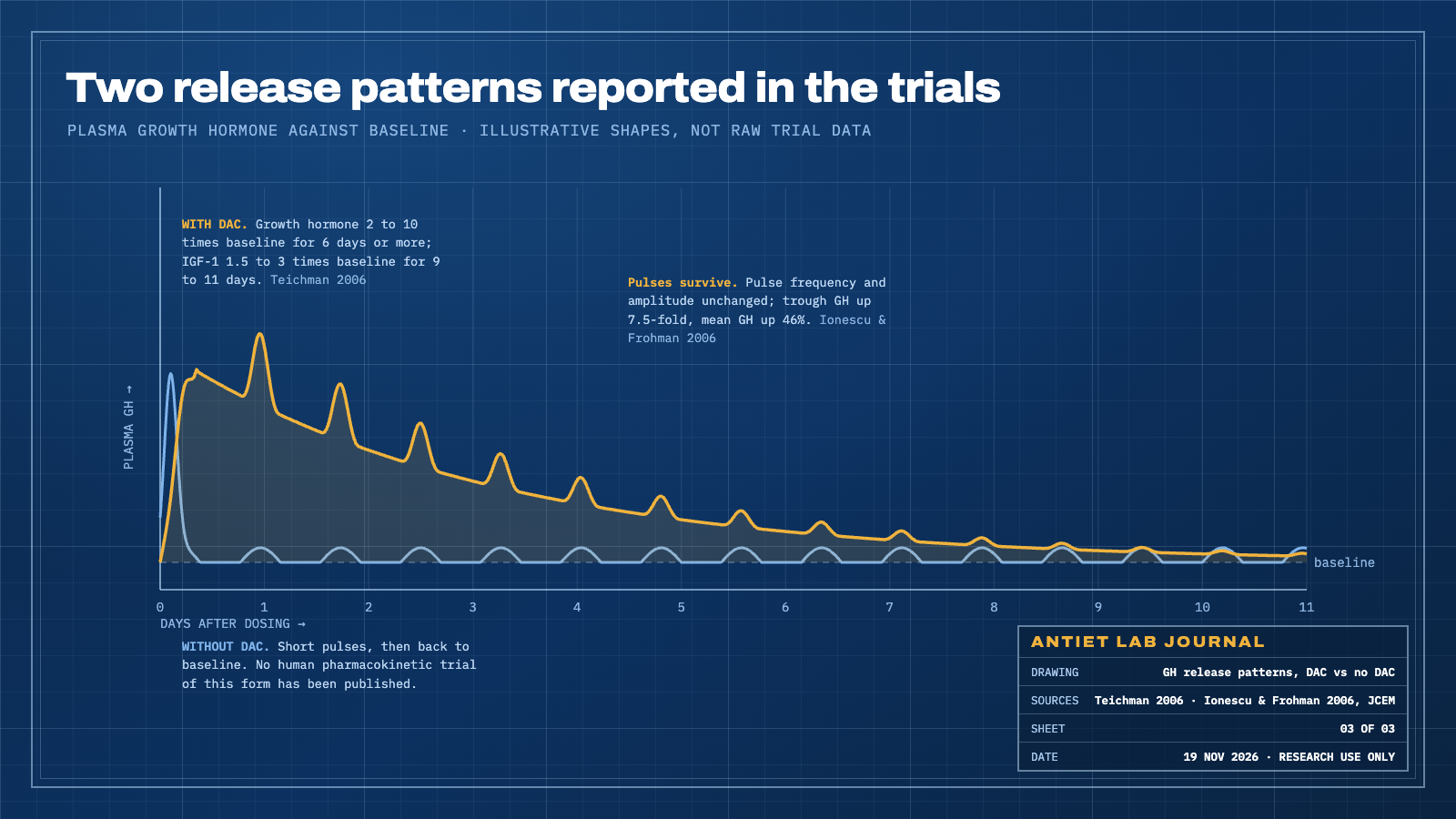
Sustained vs pulsatile growth hormone release patterns reported in CJC-1295 research
Illustrative, based on Teichman et al. 2006 and Ionescu & Frohman 2006.
Where Sermorelin Fits
The CJC-1295 vs Sermorelin comparison is really modified against the original. Sermorelin is GRF(1-29) itself, the unmodified 29-amino-acid fragment of GHRH, with none of the four substitutions and none of the albumin chemistry. Strip CJC-1295 back far enough and sermorelin is what you have left.
Sermorelin also has a regulatory history the other two never got. It reached the US market as Geref, and EMD Serono notified the FDA by letter dated 11 July 2008 that the product was being discontinued. A later Federal Register notice recorded that the products were not withdrawn from sale for reasons of safety or effectiveness. The reason was commercial, and it still shapes how sermorelin is discussed, since this is the only one of the three that was ever an approved drug.
On duration, it is at the far end of the range. The Irish regulator’s Geref 50 summary of product characteristics states that “sermorelin has a plasma half-life of 6-7 minutes after intravenous administration.” That is the figure to use, since it comes from a product label rather than a secondary summary. Antiet carries sermorelin acetate for work that needs the unmodified parent sequence as a reference point.
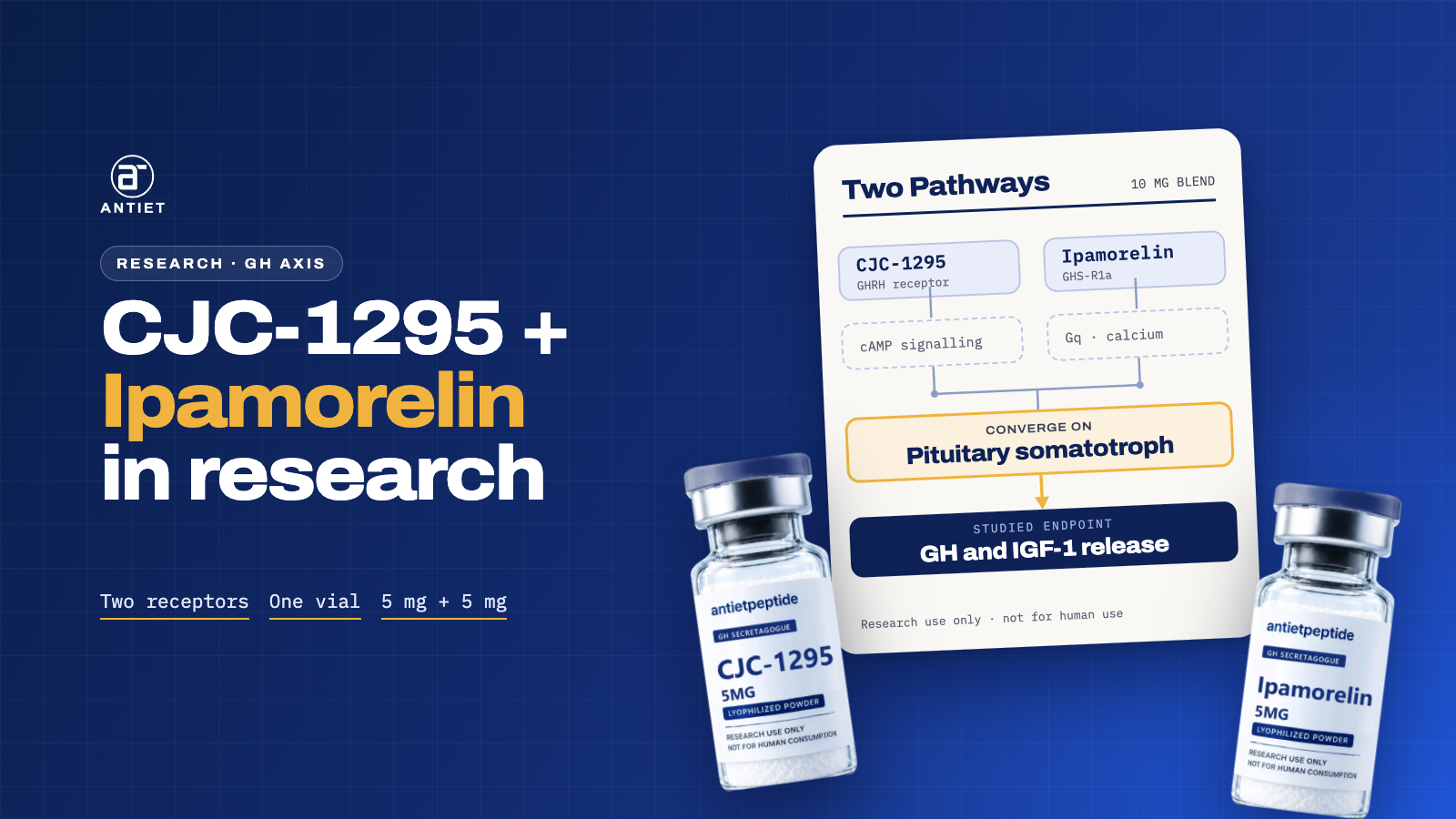
One wrinkle trips up most pages on this topic. Much of what gets filed under “CJC-1295 vs sermorelin” actually compares sermorelin against a CJC-1295 and ipamorelin combination, which is a mismatched comparison. CJC-1295 and sermorelin both act on the GHRH receptor, while ipamorelin acts on the growth hormone secretagogue receptor, which is why the CJC-1295 and ipamorelin blend is studied as a two-receptor model. Comparing one receptor against two tells you very little about DAC.
Tesamorelin is the fourth name worth knowing, as the other GHRH analog that went through clinical development and the only one of the group still approved by the FDA.
What Published Studies Show
Almost everything known about CJC-1295 in humans comes from a small set of pharmacokinetic trials run in the mid-2000s. Two were published. One was registered and stopped. Nothing since has replaced them.
Human Pharmacokinetic Trials
Teichman et al. 2006, in the Journal of Clinical Endocrinology and Metabolism, remains the reference study. Two randomised, placebo-controlled trials gave healthy adults aged 21 to 61 subcutaneous CJC-1295 with DAC in ascending single doses, then multiple doses. The authors recorded “dose-dependent increases in mean plasma GH concentrations by 2- to 10-fold for 6 d or more” and “in mean plasma IGF-I concentrations by 1.5- to 3-fold for 9-11 d.” After multiple doses, mean IGF-1 stayed above baseline for up to 28 days.
The limits are worth as much attention as the findings. These were small, short trials in healthy adults, measuring hormone concentrations rather than any clinical outcome. The paper states that “no serious adverse reactions were reported,” and describes the compound as “safe and relatively well tolerated” at the two dose levels the authors favoured. Any schedule mentioned is reported strictly as the schedule used in the published trial.
GH Pulsatility Findings
The pulsatility question got its own study. Ionescu and Frohman 2006, a human pharmacokinetic and pharmacodynamic study in the same journal, found that pulsatile growth hormone secretion persists during continuous stimulation by CJC-1295, with pulse frequency and amplitude unchanged a week after dosing.
Read that carefully. Preserved pulsatility means the rhythm of release survives, and the whole curve moves upward: trough levels rose 7.5-fold while the mean rose 46%. It does not mean the hormonal pattern stays normal, and the authors added that IGF-1 changes did not correlate with any growth hormone secretion parameter they measured.
Why Clinical Development Stopped
ConjuChem’s Phase 2 programme ended, and the public record of why is thin. The registry entry, NCT00267527, describes a multicentre, randomised, placebo-controlled, double-blind Phase 2 study of CJC-1295 over 12 weeks in 120 HIV-positive patients with HIV-associated visceral obesity, running from December 2005 to September 2006. Its overall status reads “Terminated.” No reason is posted against it.
A trial death is widely claimed across search results. It does not appear in the registry record, in either published trial, or in any primary document found for this article, so this page does not state it. Development was discontinued, and the publicly documented reasons are limited. The FDA’s own files carry a signal of their own, covered next. ConjuChem filed for bankruptcy in 2010.
Regulatory and Research Status (2026)
None of the three compounds is an FDA-approved drug today, and the paperwork behind that differs for each. All status checks below were made on 19 November 2026.
CJC-1295 has never had an approval in either form. Its position in US compounding rules is more specific than most pages suggest, because it is not currently in Category 2 of the FDA’s interim policies. It appears instead among withdrawn nominations, on the agency’s page covering bulk drug substances that may present significant safety risks, current as of 22 April 2026. That entry records serious adverse events including increased heart rate and systemic vasodilatory reaction, plus limited clinical data. Ipamorelin acetate is in Category 2 for outsourcing facilities, added 29 September 2023.
Sermorelin’s approval was withdrawn at the manufacturer’s request and never reinstated. Tesamorelin keeps an approval for a specific indication, which sets it apart from the rest of the group.
On anti-doping, the position is unambiguous. The WADA 2026 Prohibited List, in force since 1 January 2026, covers growth hormone-releasing factors at section S2.2.4: “growth hormone-releasing hormone (GHRH) and its analogues (e.g. CJC-1293, CJC-1295, sermorelin and tesamorelin).” Substances in class S2 are prohibited at all times, in and out of competition, and are non-Specified Substances.
For purchase, all three remain research-use-only materials, supplied for laboratory work and nothing else.
Telling the Compounds Apart on a COA
Because the three compounds differ in mass and sequence, a certificate of analysis can confirm which one a vial actually contains. Mass is the fastest check, and the three figures from PubChem are far enough apart to be decisive:
- CJC-1295 with DAC: 3,647.2 g/mol, formula C165H269N47O46 (CID 91971820)
- CJC-1295 no DAC / Mod GRF 1-29: 3,367.9 g/mol, formula C152H252N44O42 (CID 56841945)
- Sermorelin: 3,357.9 g/mol, formula C149H246N44O42S (CID 16132413)
Look at the last two. Ten daltons separate sermorelin from the no-DAC peptide, and only sermorelin contains sulfur, because the methionine at position 27 is swapped for leucine in the modified sequence. The DAC form stands 279 daltons clear of both. A mass spectrometry identity result tells all three apart. A purity percentage from HPLC alone reports how much of one peak is the target molecule without telling you which molecule that peak is. HPLC and mass spectrometry answer two different questions, which is why a COA needs both.
This is not a hypothetical worry. Henninge, Pepaj, Hullstein and Hemmersbach of the Norwegian Doping Control Laboratory analysed an unknown preparation for Norwegian police and customs authorities and published the result in Drug Testing and Analysis: the sample, marketed under the CJC-1295 name, “was found to contain a 29-amino-acid peptide with a C-terminal amide function.” Twenty-nine residues ending in an amide is the no-DAC peptide, not the 30-residue DAC conjugate.
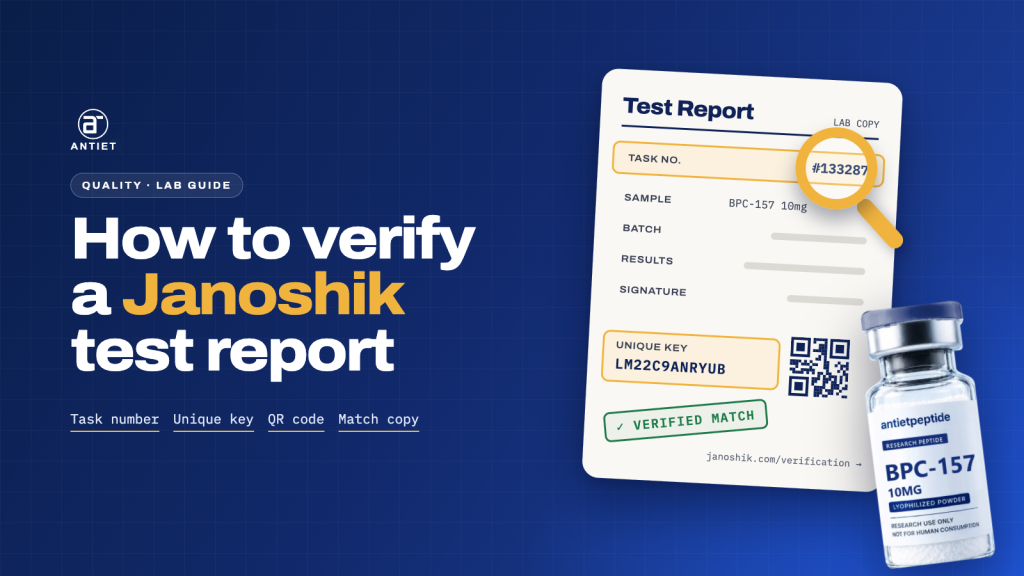
Mass settles identity, and the other fields settle other questions: purity percentage, batch number, test date. Reading a certificate of analysis properly means checking all of them, not only the headline number. A report also has to match the copy the lab stores, and verifying a Janoshik report takes five steps.
FAQs
What is the difference between DAC and no DAC?
DAC is a Drug Affinity Complex, a maleimide group that bonds covalently to cysteine-34 on serum albumin. With it, CJC-1295’s measured half-life is 5.8 to 8.1 days, and growth hormone elevation is sustained in study models. Without it, clearance is far faster and release comes in short pulses.
Is sermorelin the same as CJC-1295?
No. Sermorelin is unmodified GRF(1-29). CJC-1295 is the same 29-amino-acid fragment with four amino acids substituted, optionally plus the DAC attachment. Their histories differ too: sermorelin reached the US market as Geref, while CJC-1295 has never been approved in any form.
Is Mod GRF 1-29 the same as CJC-1295 without DAC?
Yes, two names for one peptide. “Mod GRF 1-29” grew out of “tetrasubstituted GRF(1-29)” in the 2005 literature, while “CJC-1295 no DAC” came from suppliers borrowing ConjuChem’s development code. Check the mass on the certificate of analysis to confirm which peptide a vial contains.
What is CJC-1295 with DAC studied for?
Published work on CJC-1295 with DAC covers the growth hormone and IGF-1 axis. The evidence base is two human pharmacokinetic trials from 2006 plus preclinical rat work from 2005, all measuring hormone concentrations and clearance. No outcome beyond those measurements is established.
Does CJC-1295 affect testosterone?
The published human trials measured growth hormone and IGF-1 concentrations, along with pharmacokinetic parameters such as half-life. Testosterone was not among the reported endpoints in Teichman et al. 2006 or Ionescu and Frohman 2006, so the published research says nothing either way.
What adverse events have been reported in CJC-1295 studies?
Teichman et al. 2006 reported that “no serious adverse reactions were reported” in their two trials. Separately, the FDA’s record of the withdrawn compounding nomination for CJC-1295 lists serious adverse events including increased heart rate and systemic vasodilatory reaction, and limited clinical data. The ConjuChem Phase 2 study on the public registry reads “Terminated” with no reason posted.
Is CJC-1295 on the WADA prohibited list?
Yes. The WADA 2026 Prohibited List, effective 1 January 2026, names CJC-1295 at section S2.2.4 among growth hormone releasing hormone analogues. Class S2 substances are prohibited at all times, in and out of competition, and are classed as non-Specified Substances.
The Short Version
One chemical group separates the two forms of CJC-1295, and it is the difference between a peptide measured in days and one measured in minutes. Sermorelin is the unmodified parent of both. All three are research-use-only materials, supplied for laboratory work and not for human or veterinary use, which is the position stated in Antiet’s Terms of Sale. Every batch Antiet ships carries third-party analysis, so you can check a mass against the per-batch COA index before a vial goes on the bench.
Sources
- Jetté L, Léger R, Thibaudeau K, et al. Human growth hormone-releasing factor (hGRF)1-29-albumin bioconjugates activate the GRF receptor on the anterior pituitary in rats: identification of CJC-1295 as a long-lasting GRF analog. Endocrinology 2005;146:3052-3058. https://pubmed.ncbi.nlm.nih.gov/15817669/
- Teichman SL, Neale A, Lawrence B, Gagnon C, Castaigne JP, Frohman LA. Prolonged stimulation of growth hormone (GH) and insulin-like growth factor I secretion by CJC-1295, a long-acting analog of GH-releasing hormone, in healthy adults. J Clin Endocrinol Metab 2006;91:799-805. https://pubmed.ncbi.nlm.nih.gov/16352683/
- Ionescu M, Frohman LA. Pulsatile secretion of growth hormone (GH) persists during continuous stimulation by CJC-1295, a long-acting GH-releasing hormone analog. J Clin Endocrinol Metab 2006;91:4792-4797. https://pubmed.ncbi.nlm.nih.gov/17018654/
- Henninge J, Pepaj M, Hullstein I, Hemmersbach P. Identification of CJC-1295, a growth-hormone-releasing peptide, in an unknown pharmaceutical preparation. Drug Test Anal 2010;2:647-650. https://pubmed.ncbi.nlm.nih.gov/21204297/
- ConjuChem. About DAC technology. https://www.conjuchem.com/technology/dac.html
- ClinicalTrials.gov. NCT00267527, ConjuChem Phase 2 study of CJC-1295. https://clinicaltrials.gov/study/NCT00267527
- US Food and Drug Administration. Certain bulk drug substances for use in compounding that may present significant safety risks. Current as of 22 April 2026. https://www.fda.gov/drugs/human-drug-compounding/certain-bulk-drug-substances-use-compounding-may-present-significant-safety-risks
- US Food and Drug Administration. Determination that Geref and Geref Diagnostic were not withdrawn from sale for reasons of safety or effectiveness. Federal Register, 4 March 2013. https://www.govinfo.gov/content/pkg/FR-2013-03-04/pdf/2013-04827.pdf
- Health Products Regulatory Authority (Ireland). Geref 50 summary of product characteristics. https://assets.hpra.ie/products/Human/16600/LicenseSPC_PA0285-006-001_13072006155719.pdf
- World Anti-Doping Agency. 2026 Prohibited List, section S2.2.4. In force 1 January 2026. https://www.wada-ama.org/en/prohibited-list
- National Center for Biotechnology Information. PubChem compound records CID 91971820, CID 56841945, CID 16132413. https://pubchem.ncbi.nlm.nih.gov/compound/91971820
- Roberts B. Mod GRF 1-29 peptide profile. MESO-Rx. https://thinksteroids.com/steroid-profiles/mod-grf-1-29/
This article is for general laboratory information only. Antiet products are sold strictly for research use and are not for human or veterinary use.