Two peptides, one vial, and a label that tells you almost nothing about why they’re in there together. A CJC-1295 ipamorelin blend pairs two compounds that hit two separate receptors on the same pituitary cell, which is the whole reason anyone puts them in one vial.
Quick answer: CJC-1295 is a GHRH analog that signals through the GHRH receptor. Ipamorelin is a selective ghrelin mimetic acting at GHS-R1a. Research combines them because the two pathways stimulate growth hormone release through independent mechanisms. Both are research-use-only compounds, with no FDA approval.
Research use only. Supplied for in vitro laboratory research. Not for human or veterinary use, and not a drug, food, cosmetic, or supplement, as set out in the Antiet Terms of Sale.
What Is the CJC-1295 + Ipamorelin Blend?
A CJC-1295 + ipamorelin blend is a single lyophilized vial containing both peptides, typically the no-DAC form of CJC-1295 (also called Mod GRF 1-29) together with ipamorelin. The two are freeze-dried as one powder, so a researcher reconstitutes once and draws a fixed ratio each time.
What’s in a 10mg Vial
The number on the label is a total, not a per-peptide amount. Antiet’s CJC-1295 + Ipamorelin Blend is 5 mg of CJC-1295 (no DAC) and 5 mg of ipamorelin, premixed, for 10 mg total at $134 a box of ten vials as of November 2026.
Read that number carefully, because “10 mg blend” means different things across the market. Researchers on a GLP-1 Forum thread dated 15 January 2026 note both 5+5 and 10+10 vials sell under similar wording, so one lab’s 10 mg vial contains half what another’s does.
A 1:1 ratio is commonly described as standard, and it often is, though nothing guarantees it. In that same thread, researchers who sent blend vials for third-party testing came back with roughly 6.2 mg to 4.6 mg in one lot, and about 6 mg to 5 mg in another, against labels that said 5/5. The certificate of analysis for your batch is the only thing that settles it.
Which CJC-1295 Form Blends Use
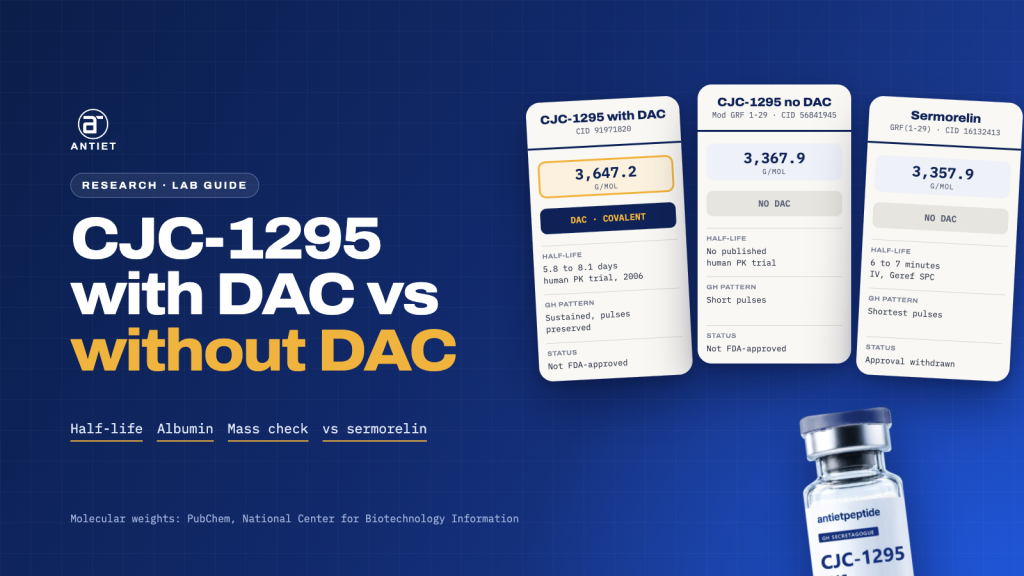
Nearly all blends use the no-DAC form. The naming gets muddled because “CJC-1295” originally meant the version carrying a Drug Affinity Complex, and the no-DAC version circulates under both that name and Mod GRF 1-29. Which form is in the vial changes the pharmacology completely, since CJC-1295 with DAC and no DAC differ by one albumin-binding group and a half-life measured in days instead of minutes.
How CJC-1295 Works: The GHRH Pathway
CJC-1295 is a modified analog of GHRH(1-29) that binds the GHRH receptor on pituitary somatotrophs, the cells that make and store growth hormone. Hitting that receptor starts a chain that both releases stored GH and tells the cell to make more.
UniProt’s entry for GHRHR describes it as “coupled to G proteins which activate adenylyl cyclase,” which in turn “stimulates somatotroph cell growth, growth hormone gene transcription and growth hormone secretion.” The signal reaches the GH gene itself, not only the release trigger.
Animal work backs that up. In GHRH knockout mice treated for five weeks, Alba and colleagues at Johns Hopkins found CJC-1295 “caused an increase in total pituitary RNA and GH mRNA, suggesting that proliferation of somatotroph cells had occurred.” Once-daily treatment kept body weight and length normal; every 48 or 72 hours did not.
The same paper explains what DAC actually does: CJC-1295 “selectively and covalently binds to endogenous albumin after injection, thereby extending its half-life and duration of action.” Strip that group off and you get the short-acting no-DAC form, which is why CJC-1295 (No DAC) and CJC-1295 with DAC behave like two different tools in a study design rather than two sizes of the same one.
How Ipamorelin Works: The Ghrelin-Mimetic Pathway
Ipamorelin is a pentapeptide that mimics ghrelin at the GHS-R1a receptor, a completely separate route to GH release from CJC-1295. Its sequence is Aib-His-D-2-Nal-D-Phe-Lys-NH2, and it came out of a Novo Nordisk chemistry programme that stripped the central Ala-Trp dipeptide out of GHRP-1.
GHS-R1a runs on a different second messenger. UniProt’s GHSR entry records it as “coupled to G(q) G proteins” and mediating “production of diacylglycerol,” signalling through phospholipase C and calcium. The GHRH receptor works through cAMP; this one works through calcium.
The compound’s lab code is NNC 26-0161, documented in Johansen and colleagues’ 1998 study in Xenobiotica. Get that detail right, because NN703 is tabimorelin, a different Novo compound often conflated with this one.
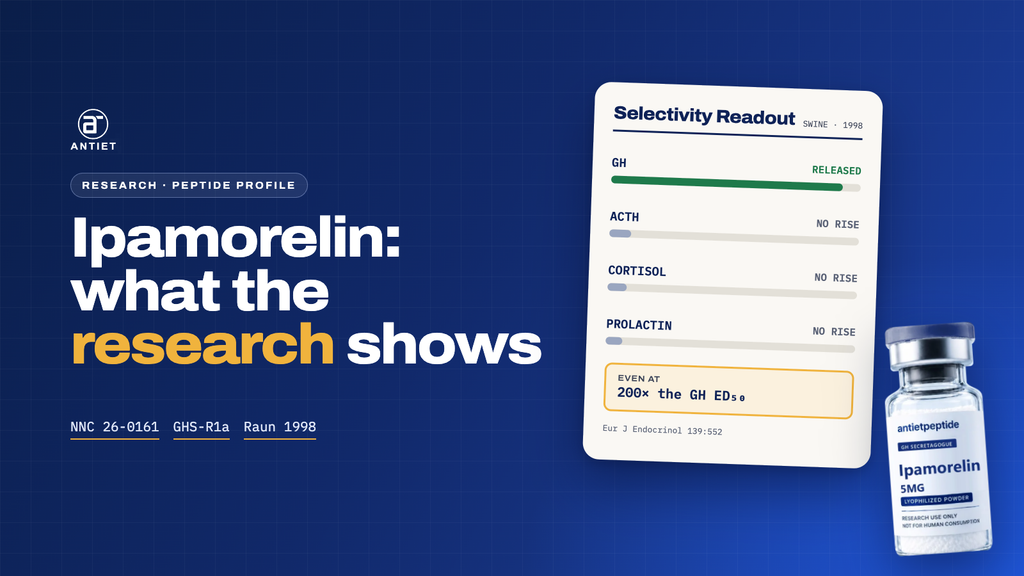
Selectivity is the finding ipamorelin is known for. In the original pharmacology paper, Raun and colleagues reported that in conscious swine, “administration of both GHRP-6 and GHRP-2 resulted in increased plasma levels of ACTH and cortisol,” while “very surprisingly, ipamorelin did not release ACTH or cortisol in levels significantly different from those observed following GHRH stimulation,” a result that persisted even at doses more than 200-fold above the ED50 for GH release. No secretagogue tested moved FSH, LH, prolactin, or TSH. That work is in vitro, rat and swine only, with no human arm.
That selectivity is what sets Ipamorelin apart within its own class. GHRP-2 Acetate and Hexarelin Acetate bind the same GHS-R1a receptor with a different hormone profile in the published work.
Why Research Combines Them
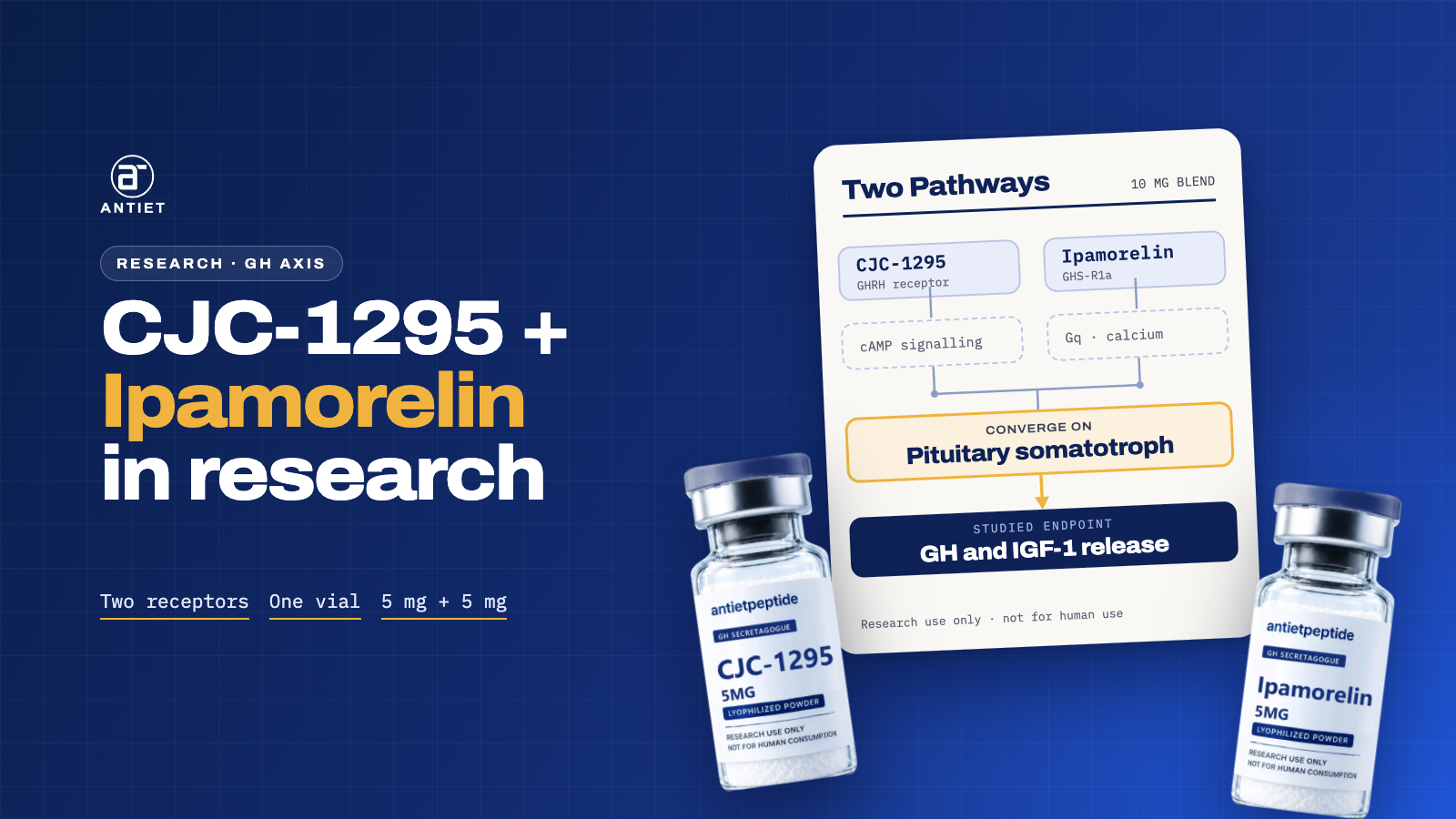
Combining a GHRH analog with a ghrelin mimetic targets growth hormone release through two independent receptor systems at once. Because the two receptors use different second messengers and converge on the same somatotroph population, the combined output in study models runs higher than either compound produces alone.
The human evidence for that belongs to the drug classes. In 1990, Bowers and colleagues gave 18 normal men a GH-releasing peptide alone and alongside GHRH. Mean peak serum GH after placebo was 1.2 µg/L, rising to 7.6, 16.5, and 68.7 µg/L across three ascending GHRP doses. The submaximal 0.1 and 0.3 µg/kg doses combined with 1 µg/kg GHRH “stimulated GH release synergistically,” and the authors concluded this “suggests that GHRP and GHRH act independently.” That independence is the basis for every GHRH-plus-secretagogue pairing since.
The second reason involves somatostatin, the brake on GH release. In his review of secretagogue development, Roy G. Smith of Baylor College of Medicine set out four ways GH pulse amplitude can be raised: more GHRH release, amplified GHRH signalling in somatotrophs, reduced somatostatin release, and antagonised somatostatin receptor signalling. His finding was that “remarkably, the GHS act through all four mechanisms.” A ghrelin mimetic therefore lifts the brake while the other compound presses the accelerator.
Pulsatility explains the no-DAC preference. Growth hormone is released in bursts, and Sigalos and Pastuszak at Baylor College of Medicine note that secretagogues “promote pulsatile release of GH that is subject to negative feedback and can prevent supra-therapeutic levels of GH and their sequelae.” A short-acting GHRH analog keeps that burst pattern in study models; the albumin-bound DAC version flattens it.
One point almost nothing on this topic states plainly: no large published human trial has tested the two compounds together as a blend. The rationale rests on class-level co-administration studies like Bowers 1990, and the GH-axis peptides in that category are stocked for this kind of mechanism work.
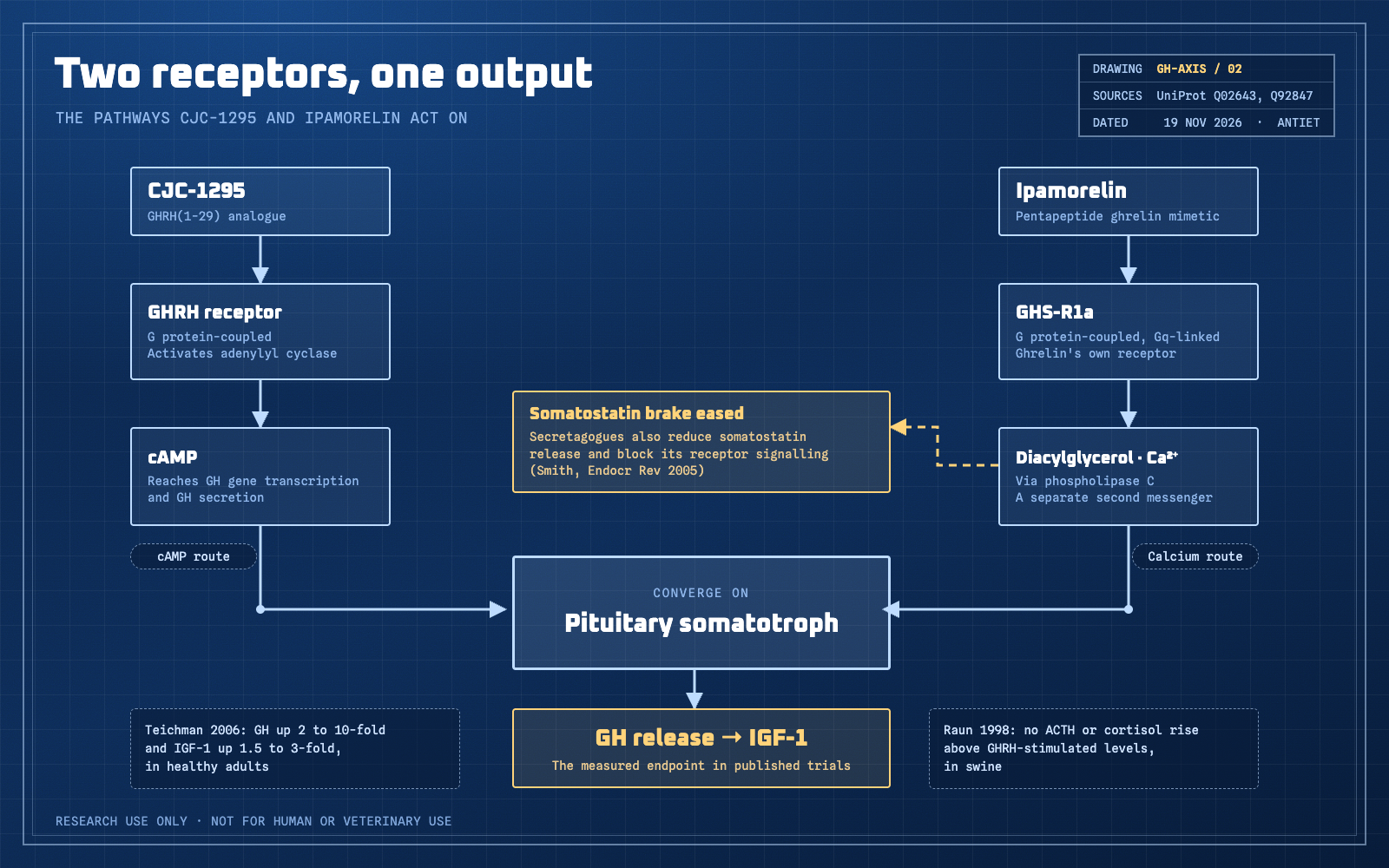
Diagram of the two receptor pathways targeted by CJC-1295 and ipamorelin
Table 1. CJC-1295 and ipamorelin side by side
| Field | CJC-1295 | Ipamorelin |
|---|---|---|
| Class | GHRH(1-29) analog | Pentapeptide ghrelin mimetic |
| Receptor | GHRH receptor, on somatotrophs | Secretagogue receptor GHS-R1a |
| Signalling pathway | Adenylyl cyclase and cAMP; reaches GH gene transcription | Gq-linked; diacylglycerol via phospholipase C, then calcium |
| Half-life in published studies | 5.8 to 8.1 days, DAC form, in adults (Teichman 2006); none found for no-DAC | None found in humans; in rats, clearance five-fold under GHRP-6 (Johansen 1998) |
| Development origin | ConjuChem; albumin-binding DAC design | Novo Nordisk A/S, Måløv; lab code NNC 26-0161 |
| Selectivity notes | ACTH and cortisol were not endpoints in the human trial | No ACTH or cortisol rise above GHRH-stimulated levels in swine |
| Research status | No FDA approval; Phase 2 NCT00267527 terminated | No FDA approval; two Phase 2 ileus trials, endpoint not met |
What Published Studies Show
Three registered trials cover these two compounds, and none of them tested the blend. CJC-1295 has one published human study plus a terminated Phase 2. Ipamorelin has animal GH pharmacology plus two Phase 2 trials in a completely different indication. Every finding below is labelled by study type, because animal results and human results get blurred together in most claims about this pairing.
CJC-1295 Human Data
One human trial carries most of the weight, and it studied CJC-1295 alone. Teichman and colleagues ran two randomised, placebo-controlled, double-blind ascending-dose trials over 28 and 49 days in healthy subjects aged 21 to 61, published in the Journal of Clinical Endocrinology & Metabolism in 2006. After a single injection, mean plasma GH rose 2- to 10-fold for six days or more, and mean plasma IGF-I rose 1.5- to 3-fold for nine to eleven days. Half-life came out at 5.8 to 8.1 days. After multiple doses, mean IGF-I stayed above baseline for up to 28 days.
One scope limit shapes everything that trial can tell you: it tested the DAC-bearing form alone, with no ipamorelin and no blend. A second CJC-1295 study, NCT00267527, ran in HIV patients with visceral obesity from December 2005 with 120 enrolled by sponsor ConjuChem. Its registry status is terminated.
Ipamorelin Studies
Ipamorelin’s GH-release pharmacology is animal work. Raun 1998 measured potency in rat pituitary cells (EC50 1.3 nmol/l), in anaesthetised rats and in conscious swine, each time close to GHRP-6.
Its clinical development went to postoperative ileus. Helsinn Therapeutics ran two Phase 2 trials. NCT00672074 enrolled 117 bowel-resection patients and was published by Beck and colleagues in the International Journal of Colorectal Disease. The larger NCT01280344 enrolled 320 people and was completed in May 2014. In the first, median time to first tolerated meal was 25.3 hours on ipamorelin against 32.6 hours on placebo, p = 0.15. The authors concluded there were “no significant differences between ipamorelin and placebo in the key and secondary efficacy analyses.” No Phase 3 programme followed.
Evidence for the Combination Itself
No published human trial has tested a CJC-1295 and ipamorelin blend. What exists is co-administration work on the two classes: Bowers 1990 pairing a GH-releasing peptide with GHRH in 18 men, plus later dual-secretagogue studies such as Paulo and colleagues’ 2008 work at the Mayo Clinic, which found body mass index accounted for 62% of GH response variability after GHRH/GHRP-2 in eugonadal men. Those are class-level findings, not findings about this vial.
Reported Adverse Events and Hormone Endpoints
The adverse events on record come from the individual compounds’ trials and from regulatory filings, not from studies of the blend. The most specific source is the FDA’s own category listing.
On CJC-1295, the agency writes that compounded drugs containing it “may pose risk for immunogenicity for certain routes of administration,” and that it “has identified serious adverse events associated with CJC-1295 including increased heart rate and systemic vasodilatory reaction. Available clinical data are limited.” The Teichman trial itself recorded no serious adverse events and described the compound as relatively well tolerated at 30 or 60 µg/kg.
On ipamorelin, the FDA’s entry flags immunogenicity risk “due to the potential for aggregation or peptide-related impurities,” notes the compound “contains unnatural amino acids, which add to the complexity of peptide characterization,” and states that “a study published in literature identified serious adverse events including death when ipamorelin was administered intravenously for improving gastric motility.” The ileus trial it cites recorded treatment-emergent adverse events in 87.5% of the ipamorelin group against 94.8% on placebo.
The hormone endpoints measured were GH and IGF-I in the CJC-1295 trial, and GH with ACTH, cortisol, FSH, LH, prolactin, and TSH in the animal ipamorelin pharmacology. Testosterone was not an endpoint in any of the three registered trials, so no trial data exists on it either way. Sigalos and Pastuszak add one class-level caution from the human literature: “some concern for increases in blood glucose because of decreases in insulin sensitivity.”
Regulatory Status (November 2026)
Neither compound is FDA-approved for any indication, and the agency’s compounding lists place the two differently. On the FDA’s page of bulk drug substances that may present significant safety risks, content current as of 22 April 2026, ipamorelin acetate appears in Category 2 under the 503B policy for outsourcing facilities. CJC-1295 appears in the separate table of nominations withdrawn by the nominators, so it is not on the 503A bulk list.
Those two placements mean different things. Category 2 is where the FDA puts substances it has reviewed and found to carry potential safety risks, so a pharmacy cannot compound with them under the interim policies. A withdrawn nomination means nobody is now asking the agency to approve that substance, which leaves CJC-1295 off the list by default. Either way, no legal compounding route exists for either compound today.
Three related secretagogues share that Category 2 placement: GHRP-2 for injectable and nasal routes, GHRP-6, and ibutamoren mesylate. Look at which evidence the FDA leans on. The reference it cites alongside ipamorelin acetate is the Beck ileus trial described above, the full extent of the published human record available to it.
In sport, both are prohibited by name. The WADA 2026 Prohibited List, in force from 1 January 2026, covers them under S2.2.4, growth hormone-releasing factors, prohibited at all times as non-Specified Substances. It names “growth hormone-releasing hormone (GHRH) and its analogues (e.g. CJC-1293, CJC-1295, sermorelin and tesamorelin)” and, separately, “growth hormone secretagogues (GHS) and their mimetics,” whose examples include ipamorelin and tabimorelin.
Verifying a Blend on a COA
A blend vial should show both peptides on its certificate of analysis, two identity confirmations rather than one. A single peak and a single purity figure tell you about one compound and leave the other unverified.
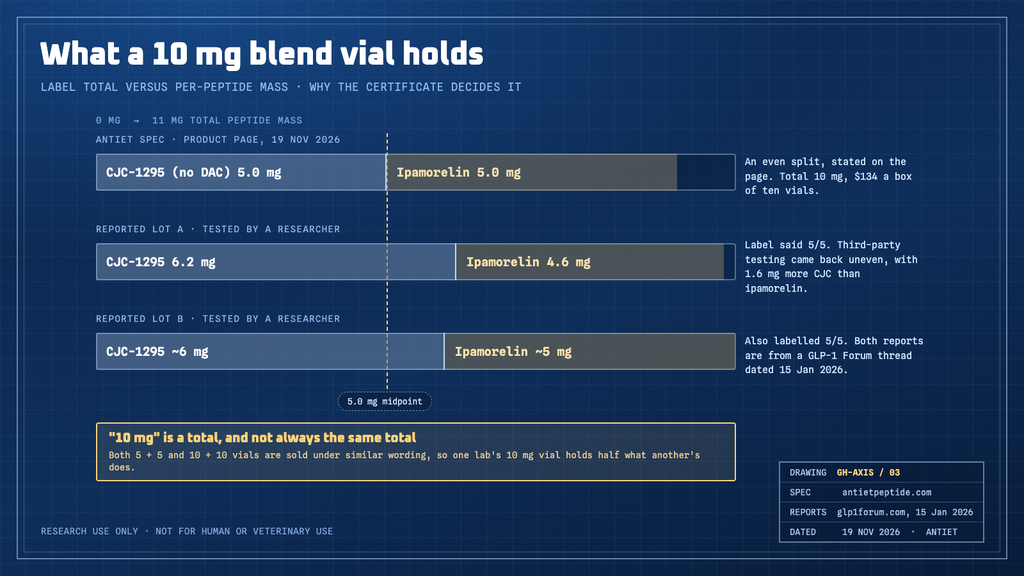
What a 10mg CJC-1295 ipamorelin blend vial contains
Three things to check. First, two separate identity confirmations, since analytical HPLC resolves the peptides as distinct peaks and identity work should name both. Second, per-peptide mass against the label claim, since a 10 mg total says nothing about the ratio. Third, which CJC form the vial holds, because DAC and no-DAC are different molecules.
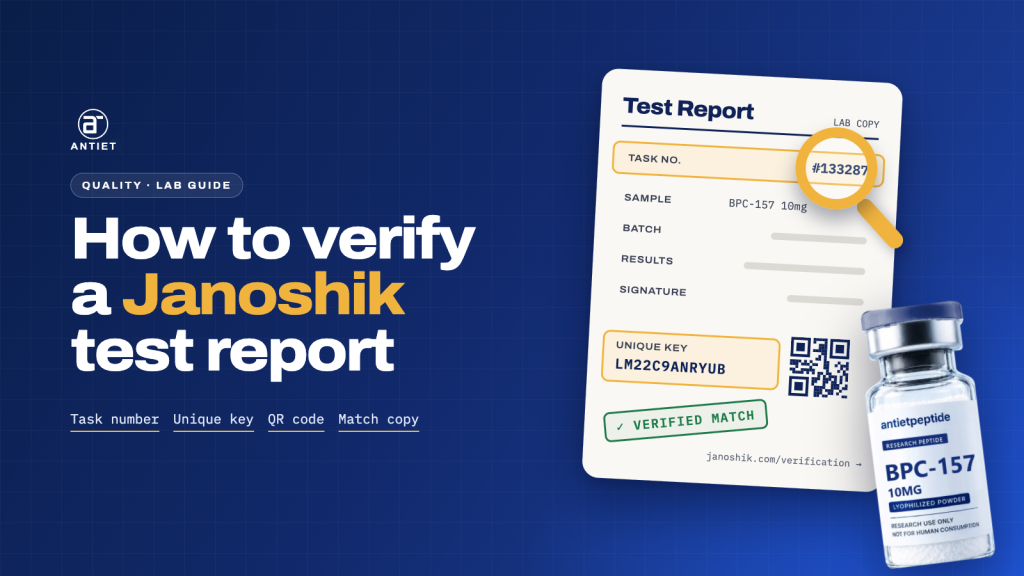
Learning to read a peptide certificate of analysis field by field is the groundwork here, and because a PDF alone proves nothing, you can verify a Janoshik test report against the lab’s stored copy in about a minute. The distinction between HPLC and mass spectrometry decides which question a report can answer: how much, or which molecule.
FAQs
What does the CJC-1295 and ipamorelin blend do?
In published research, the two compounds are studied for effects on the GH and IGF-1 axis through two separate receptor pathways. Human data exists for CJC-1295 alone (Teichman 2006) and animal data for ipamorelin’s GH release (Raun 1998). No human trial has studied the blend.
What is CJC-1295 ipamorelin studied for?
Research areas on record are growth hormone and IGF-1 secretion, studied in healthy adults for CJC-1295 with DAC, and GH release plus hormone selectivity for ipamorelin in rat and swine models. Ipamorelin’s clinical development targeted postoperative ileus in two Phase 2 trials.
What are the downsides to CJC-1295 ipamorelin?
The FDA records serious adverse events for CJC-1295 including increased heart rate and systemic vasodilatory reaction, and for intravenous ipamorelin including death, both from the individual compounds’ literature. The agency also flags immunogenicity risk for both. No combination-trial safety data exists.
Does CJC mess with testosterone?
The registered trials measured growth hormone and IGF-I, with ACTH, cortisol, prolactin, FSH, LH and TSH added in the animal ipamorelin pharmacology. Testosterone was not an endpoint in any of them, so no trial data supports a claim in either direction.
Is the blend always a 1:1 ratio?
A 1:1 ratio is commonly described as standard, and it is what Antiet’s 10 mg vial contains, at 5 mg of each. It varies by vendor, and researchers report tested lots coming back uneven against their labels. Your batch certificate of analysis is the authority.
Why is ipamorelin on the WADA prohibited list?
The WADA 2026 Prohibited List includes growth hormone secretagogues and their mimetics under S2.2.4, prohibited at all times, and names ipamorelin among its examples. GHRH analogues, including CJC-1295, appear in the same section. The list took effect on 1 January 2026.
Is CJC-1295 ipamorelin FDA-approved?
No. Neither compound is FDA-approved for any indication. Ipamorelin acetate is in Category 2 of the agency’s compounding lists, meaning it may present significant safety risks, and the nomination to add CJC-1295 to the 503A bulks list was withdrawn by its nominators.
Two receptors, two second messengers, one well-documented class-level synergy from 1990, and no human trial of the blend itself. The mechanism is solid, and the outcome data is thin, which is why the certificate of analysis on your batch does more for a study’s integrity than any claim on a label.
Antiet products are supplied for in vitro laboratory research use only. They are not for human or veterinary use, and are not drugs, foods, cosmetics or supplements. The Antiet Terms of Sale set out the full conditions of supply.
Sources
- Teichman SL, Neale A, Lawrence B, Gagnon C, Castaigne JP, Frohman LA. Prolonged stimulation of growth hormone (GH) and insulin-like growth factor I secretion by CJC-1295, a long-acting analog of GH-releasing hormone, in healthy adults. J Clin Endocrinol Metab 2006;91(3):799-805. https://pubmed.ncbi.nlm.nih.gov/16352683/
- Raun K, Hansen BS, Johansen NL, Thøgersen H, Madsen K, Ankersen M, Andersen PH. Ipamorelin, the first selective growth hormone secretagogue. Eur J Endocrinol 1998;139(5):552-61. https://pubmed.ncbi.nlm.nih.gov/9849822/
- Johansen PB, Hansen KT, Andersen JV, Johansen NL. Pharmacokinetic evaluation of ipamorelin and other peptidyl growth hormone secretagogues with emphasis on nasal absorption. Xenobiotica 1998;28(11):1083-92. https://pubmed.ncbi.nlm.nih.gov/9879640/
- Bowers CY, Reynolds GA, Durham D, Barrera CM, Pezzoli SS, Thorner MO. Growth hormone (GH)-releasing peptide stimulates GH release in normal men and acts synergistically with GH-releasing hormone. J Clin Endocrinol Metab 1990;70(4):975-82. https://pubmed.ncbi.nlm.nih.gov/2108187/
- Smith RG. Development of growth hormone secretagogues. Endocr Rev 2005;26(3):346-60. https://pubmed.ncbi.nlm.nih.gov/15814848/
- Alba M, Fintini D, Sagazio A, Lawrence B, Castaigne JP, Frohman LA, Salvatori R. Once-daily administration of CJC-1295, a long-acting growth hormone-releasing hormone (GHRH) analog, normalizes growth in the GHRH knockout mouse. Am J Physiol Endocrinol Metab 2006;291(6):E1290-4. https://pubmed.ncbi.nlm.nih.gov/16822960/
- Beck DE, Sweeney WB, McCarter MD; Ipamorelin 201 Study Group. Prospective, randomized, controlled, proof-of-concept study of the ghrelin mimetic ipamorelin for the management of postoperative ileus in bowel resection patients. Int J Colorectal Dis 2014;29(12):1527-34. https://pubmed.ncbi.nlm.nih.gov/25331030/
- Sigalos JT, Pastuszak AW. The Safety and Efficacy of Growth Hormone Secretagogues. Sex Med Rev 2018;6(1):45-53. https://pmc.ncbi.nlm.nih.gov/articles/PMC5632578/
- Paulo RC, Cosma M, Soares-Welch C, et al. Gonadal status and body mass index jointly determine growth hormone (GH)-releasing hormone/GH-releasing peptide synergy in healthy men. J Clin Endocrinol Metab 2008;93(3):944-50. https://pubmed.ncbi.nlm.nih.gov/18073313/
- US Food and Drug Administration. Certain Bulk Drug Substances for Use in Compounding that May Present Significant Safety Risks. Content current as of 22 April 2026. https://www.fda.gov/drugs/human-drug-compounding/certain-bulk-drug-substances-use-compounding-may-present-significant-safety-risks
- World Anti-Doping Agency. The 2026 Prohibited List, S2.2.4. In force 1 January 2026. https://www.wada-ama.org/en/prohibited-list
- ClinicalTrials.gov. NCT00672074, NCT01280344, NCT00267527. Accessed 19 November 2026. https://clinicaltrials.gov/study/NCT00672074
- UniProt Consortium. GHRHR (Q02643) and GHSR (Q92847). Accessed 19 November 2026. https://www.uniprot.org/uniprotkb/Q02643/entry
- GLP-1 Forum. Ipamorelin + CJC 1295 experiences. Thread dated 15 January 2026. https://glp1forum.com/threads/ipamorelin-cjc-1295-experiences.10017/
This article is for general laboratory information only. Antiet products are sold strictly for research use and are not for human or veterinary use.