Ipamorelin is a small synthetic peptide that prompts the pituitary gland to release growth hormone, and it carries one of the strangest backstories in peptide research. A major pharmaceutical company built it, a 1998 paper called it the first of its kind, it reached human trials for a gut-recovery condition, and then development stopped. Most pages about Ipamorelin skip that story. This one sticks to the published record: the original pharmacology, the trial results, and the regulatory facts, all sourced and dated.
Quick answer: Ipamorelin is a synthetic pentapeptide developed at Novo Nordisk under the code NNC 26-0161. It stimulates growth hormone release by mimicking ghrelin at the GHS-R1a receptor, and the original research describes it as the first selective GH secretagogue. It has no FDA approval and is a research-use-only compound.
Research use only. Supplied for in vitro laboratory research. Not for human or veterinary use, and not a drug, food, cosmetic, or supplement, as set out in the Antiet Terms of Sale.
What Is Ipamorelin?
Ipamorelin is a five-amino-acid synthetic peptide that triggers growth hormone release through the ghrelin receptor. Chemists call a peptide this short a pentapeptide, and this one belongs to a class known as growth hormone secretagogues: compounds that make the body’s own pituitary cells secrete GH, as opposed to supplying the hormone itself.
The compound’s structure is unusual for its size. Its sequence is Aib-His-D-2-Nal-D-Phe-Lys-NH₂, and three of its five building blocks are non-natural amino acids, which is part of what makes it stable enough to study. PubChem records Ipamorelin under CID 9831659 with the formula C₃₈H₄₉N₉O₅ and a molecular weight of 711.9 g/mol.
| Ipamorelin Quick Facts | |
|---|---|
| Sequence | Aib-His-D-2-Nal-D-Phe-Lys-NH₂ |
| Molecular formula | C₃₈H₄₉N₉O₅ |
| Molecular weight | 711.9 g/mol |
| CAS number | 170851-70-4 |
| Class | Growth hormone secretagogue (ghrelin mimetic) |
| Receptor | GHS-R1a |
| Development code | NNC 26-0161 |
| Regulatory status | No FDA approval; research use only |
In a catalogue, you’ll find Ipamorelin listed alongside the other growth hormone research peptides, usually as a lyophilized powder sold by vial strength. The name on the label is the easy part. What the compound actually does, and how well that’s documented, takes a little more unpacking.
Who Developed Ipamorelin? The Novo Nordisk Story
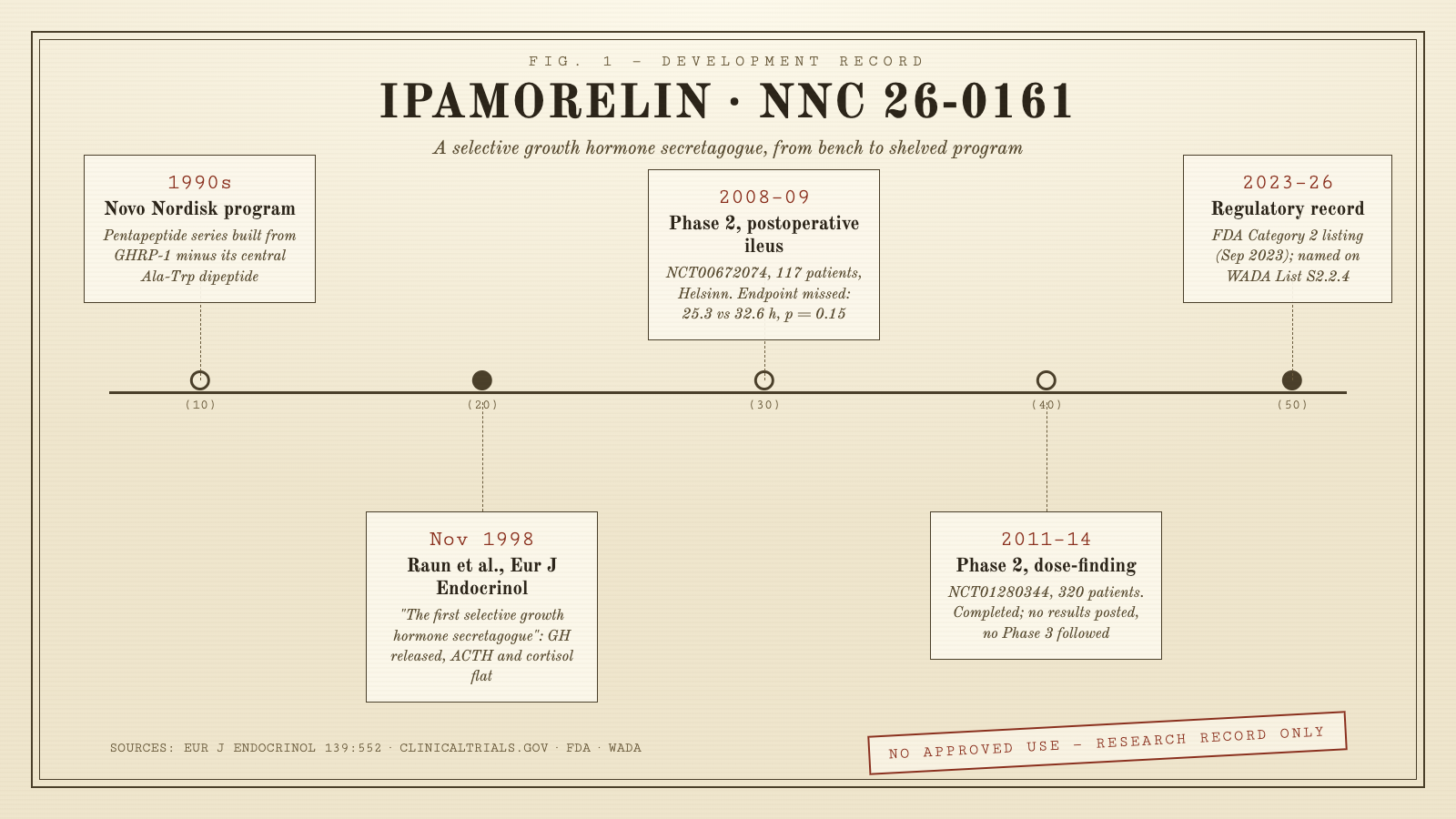
Ipamorelin was developed in the 1990s at Novo Nordisk, the Danish pharmaceutical company best known today for semaglutide, under the internal compound code NNC 26-0161. It came out of a deliberate search for a growth hormone secretagogue without the side-hormone effects of the earlier GHRPs.
Growth hormone-releasing peptides, or GHRPs, date back to work on enkephalin analogs in the late 1970s and 1980s, which produced GHRP-6 and later GHRP-2. Both release GH strongly. The catch was that they also nudge hormones nobody asked them to touch, raising ACTH and cortisol, the body’s main stress hormones. For any serious development program, that off-target profile was a problem worth engineering away.
Novo Nordisk’s chemists started from GHRP-1 and removed its central Ala-Trp dipeptide, then rebuilt the remaining fragment into a series of five-residue compounds. Ipamorelin came out of that series as the lead compound. Raun and colleagues published the pharmacology in the European Journal of Endocrinology in November 1998, with a title that made the claim plainly: “Ipamorelin, the first selective growth hormone secretagogue.”
Novo Nordisk took it into early human studies, and clinical development later passed to Helsinn Therapeutics, the US arm of the Swiss group Helsinn, which sponsored both Phase 2 trials on record. More on how those went below, because that part of the story is the one the internet keeps leaving out.
How Ipamorelin Works
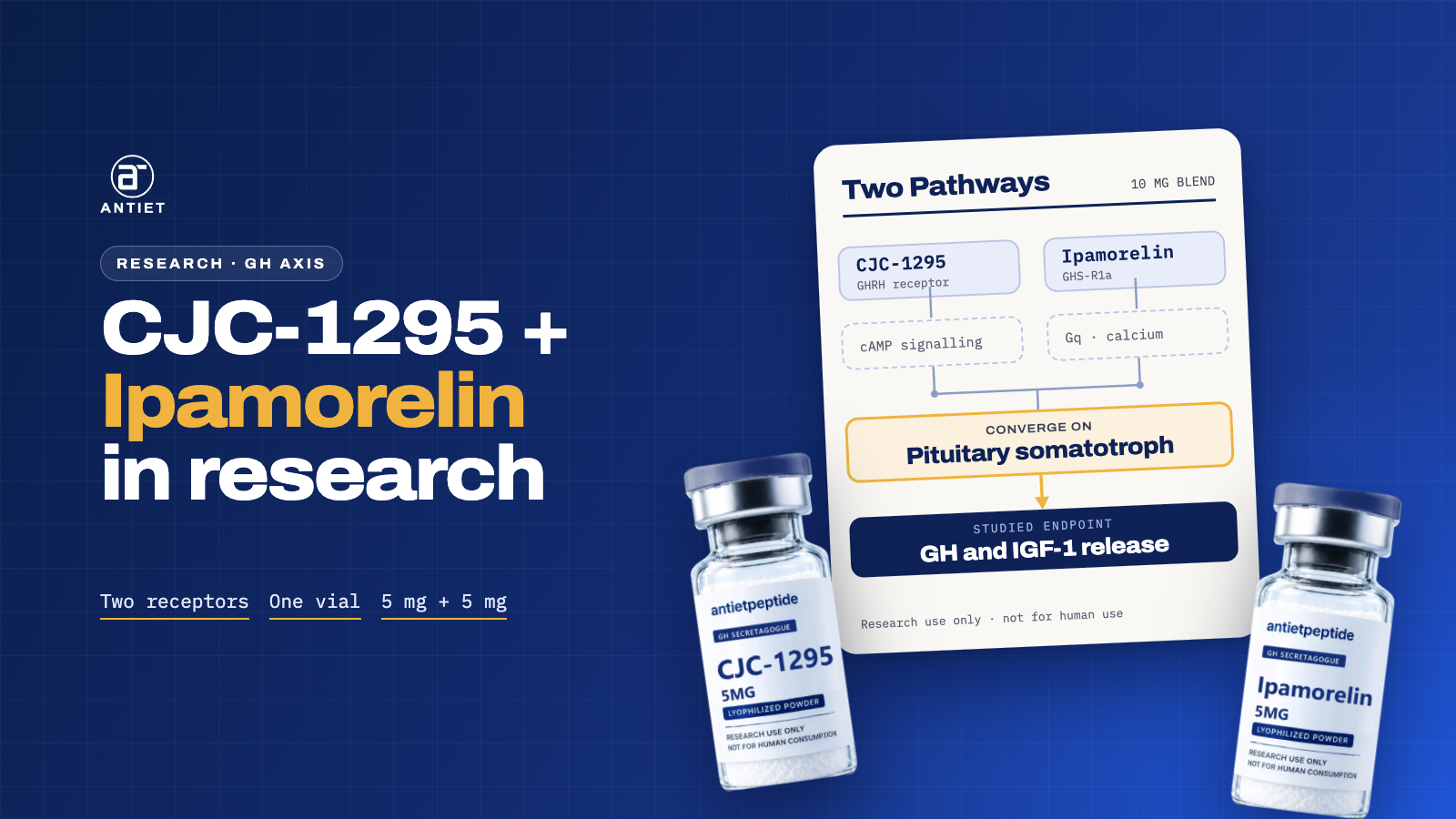
Ipamorelin mimics ghrelin at the GHS-R1a receptor on pituitary somatotrophs, the cells that store and release growth hormone. Ghrelin is best known as the hunger hormone, and GHS-R1a is its receptor; Ipamorelin binds there and sets off the same GH-release signal, which runs through calcium rather than the cAMP route that GHRH uses.
Human data exists on this, which is rare for a research peptide. In a dose-escalation study in healthy volunteers, Gobburu and colleagues infused Ipamorelin and measured what happened: GH rose in “a single episode of GH release with a peak at 0.67 hours,” then declined, and the compound itself showed “a short terminal half-life of 2 hours” with dose-proportional kinetics. A 2026 review in Frontiers in Endocrinology by Dominikowski and colleagues summarises the same phase I picture: a clear GH response peaking around 40 to 60 minutes, with minimal activation of other pituitary-adrenal signals.
That pulse pattern is the point. The pituitary normally releases GH in bursts every few hours, mostly at night, so a secretagogue that produces one clean, short-lived burst mimics the natural rhythm in study models instead of flattening it. Downstream, GH drives the liver to produce IGF-1, the readout most GH-axis research actually measures. The same study also found dose-proportional kinetics across a 33-fold dose range, the kind of predictable behaviour that makes a compound usable as a reference tool.
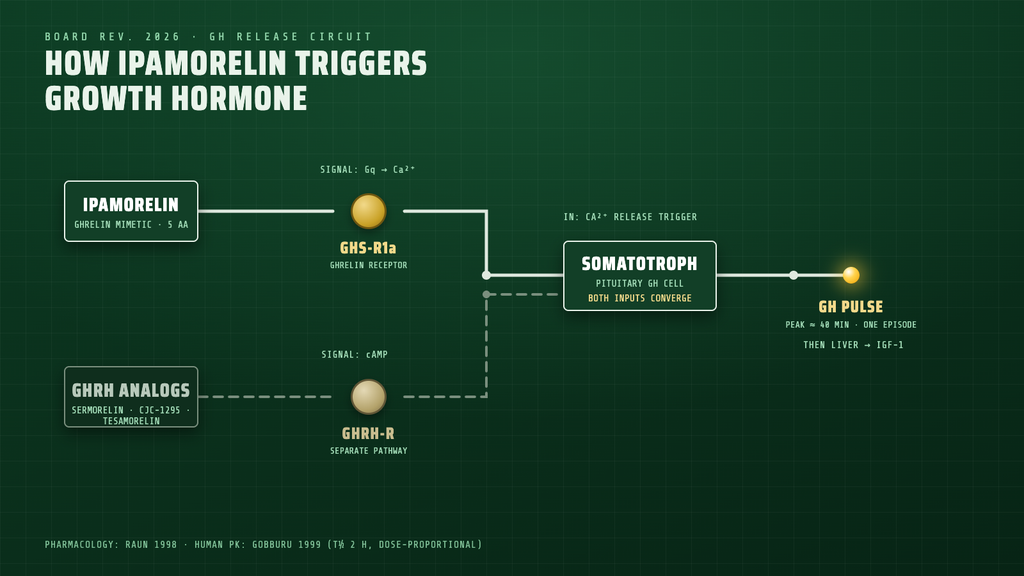
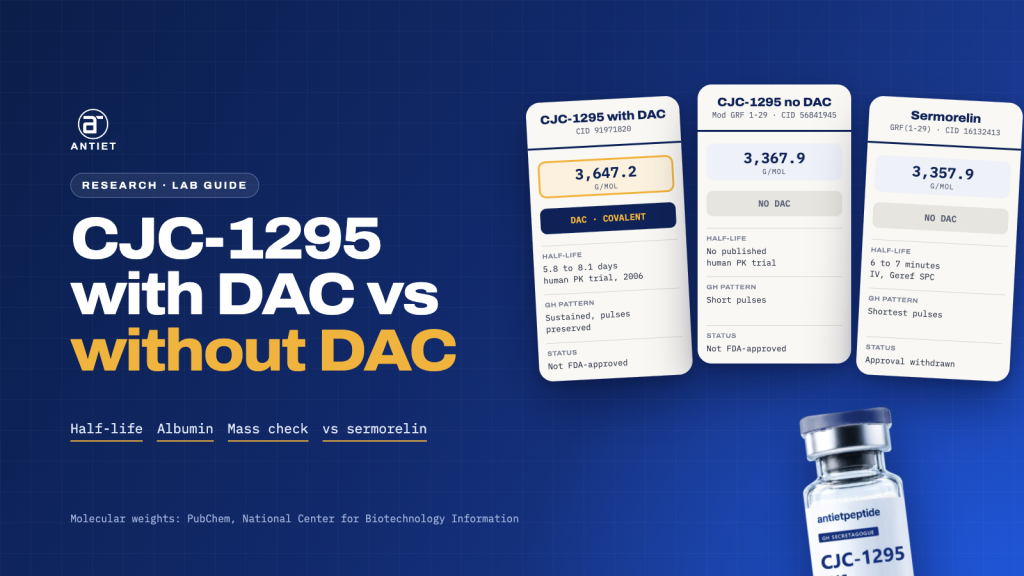
There’s a second, entirely separate route to GH release: the GHRH receptor, the one CJC-1295 in its DAC and no-DAC forms works through. The two pathways are why research protocols often pair Ipamorelin with a GHRH-side compound, most commonly as a premixed CJC-1295 + Ipamorelin blend.
Why Is Ipamorelin Called “Selective”?
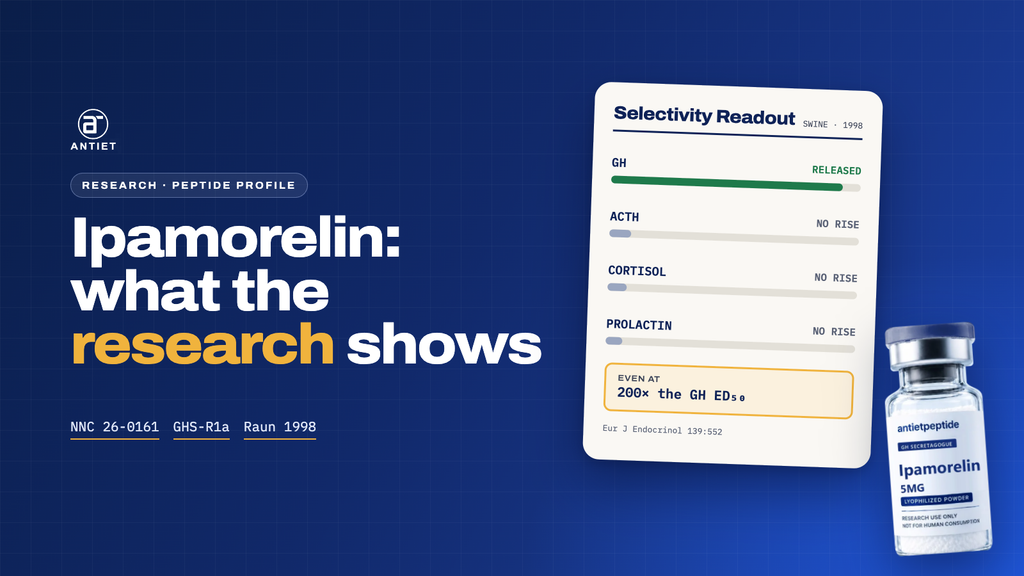
In the original 1998 pharmacology study, Ipamorelin released growth hormone without the rise in cortisol and ACTH seen with earlier GHRPs, and that finding is the entire basis of the “selective” label.
In vitro, on primary rat pituitary cells, Raun’s team measured Ipamorelin at an EC₅₀ of 1.3 nmol/l against 2.2 nmol/l for GHRP-6, with 85% of GHRP-6’s maximal response. In conscious swine, Ipamorelin’s ED₅₀ for GH release was 2.3 nmol/kg against 3.9 for GHRP-6, while GHRP-2 was more potent at 0.6 nmol/kg but less effective at its peak. So on raw GH release, the three compounds are in the same league.
The separation came in the other hormones. The paper reports that “administration of both GHRP-6 and GHRP-2 resulted in increased plasma levels of ACTH and cortisol,” while Ipamorelin “did not release ACTH or cortisol in levels significantly different from those observed following GHRH stimulation.” That held even at doses more than 200-fold above its GH ED₅₀. None of the tested compounds moved FSH, LH, prolactin, or TSH. The authors’ conclusion: Ipamorelin is “the first GHRP-receptor agonist with a selectivity for GH release similar to that displayed by GHRH.”
Two caveats belong next to those numbers. Those figures are animal and in-vitro pharmacology, so they describe hormone profiles in study models and nothing beyond that. And “selective” is a comparison within a class, a statement about hormone profile rather than potency or any outcome: GHRP-2 Acetate and Hexarelin Acetate hit the same GHS-R1a receptor with broader hormone effects in the published work, which is exactly why they remain useful comparators in receptor studies.
What Happened in Ipamorelin’s Clinical Trials?
Ipamorelin reached Phase 2 human trials, and the condition it was tested for surprises most readers: postoperative ileus, the sluggish gut function that follows bowel surgery. The logic was sound. The ghrelin receptor influences gut motility as well as GH release, so a ghrelin mimetic might plausibly wake the gut up after an operation.
Helsinn ran two Phase 2 studies. The first, NCT00672074, enrolled 117 adults recovering from bowel resection and compared twice-daily intravenous Ipamorelin against placebo. Beck and colleagues published the results in 2014: median time to first tolerated solid meal was 25.3 hours with Ipamorelin versus 32.6 hours with placebo, and that difference did not reach statistical significance (p = 0.15). In the authors’ words, “there were no significant differences between Ipamorelin and placebo in the key and secondary efficacy analyses.”
A second, larger study, NCT01280344, was built to answer the dose question the first trial left open. It enrolled 320 bowel-resection patients across three Ipamorelin arms and placebo, ran from 2011, and completed in May 2014. No results were ever posted to the registry, and no Phase 3 followed. Nothing official uses the word “discontinued,” so this article won’t either; the registry record simply ends there, and no later Ipamorelin trial appears anywhere on ClinicalTrials.gov.
That’s the full human evidence base: a gut-motility program that missed its endpoint. There are no human trials of Ipamorelin for body composition, muscle, fat, or longevity endpoints, and there never have been. Any guide implying otherwise is borrowing evidence from a different compound, a different population, or thin air.
Adverse Events Reported in Studies
The adverse events on record for Ipamorelin come from its trial program and published studies, and they read differently from the tidy lists on wellness-clinic pages. Those pages tend to recycle class effects as if they were documented findings for this specific compound.
What’s actually documented is this. In the Beck trial, treatment-emergent adverse events occurred in 87.5% of Ipamorelin patients and 94.8% of placebo patients, a profile the authors summarised as “well tolerated” in a post-surgical population where almost everyone reports something. The phase I volunteer work reported a clean GH response without notable effects on other hormone axes. Specific event types were not broken out in the published abstracts, which is itself worth knowing: the public record is thin, and thin is different from clean.
At class level, the 2026 Frontiers in Endocrinology review catalogues the adverse events documented across GH-axis peptide studies, including cortisol and prolactin elevations, appetite changes, glucose disturbances, fluid retention and injection-site reactions, and notes “the uncertainty surrounding product composition” in unregulated supply chains as a risk in its own right. The FDA makes a related point about the compound itself, flagging immunogenicity risk from aggregation and peptide-related impurities in compounded Ipamorelin.
The material-quality point has hard numbers behind it. When Verbeke and colleagues at Ghent University analysed 98 research-grade synthetic peptides, every one arrived with a certificate claiming at least 95% purity, yet “only 43 out of 98 peptides met these purity specifications.” For research buyers, that pushes the practical risk question away from the molecule and toward the specific vial on the bench, which is a documentation problem before it is anything else.
Ipamorelin vs Sermorelin
Ipamorelin and sermorelin both appear in growth-hormone research, and they act on entirely different receptors. Ipamorelin imitates ghrelin; sermorelin imitates GHRH.
Sermorelin is a 29-amino-acid fragment of growth hormone-releasing hormone, known as GRF 1-29, and it binds the GHRH receptor. Structurally, it’s a different animal: nearly six times Ipamorelin’s length and built entirely from natural amino acids, which is exactly why enzymes in plasma chew through it so fast. The 2026 Frontiers review lists its disappearance half-life at roughly 4.3 minutes, against the 2-hour terminal half-life measured for Ipamorelin in human volunteers. Ipamorelin’s engineered, partly non-natural backbone is what buys that stability, and the difference shows up directly in how each compound behaves in a study design.
Their regulatory histories diverge too. Sermorelin was an approved medicine: the FDA approved it as Geref in December 1990 under NDA 019863, and when the product was later discontinued, a 2013 Federal Register determination recorded that it was not withdrawn for safety or effectiveness reasons. Ipamorelin never reached approval under any name. Today both are research-use-only compounds, and both appear in the same section of the WADA list, covered below.
The bigger mechanistic differences between the GHRH-side compounds have their own write-up in the CJC-1295 DAC vs no DAC comparison, which includes sermorelin’s place in that family.
Ipamorelin vs Tesamorelin
Regulatory status is the cleanest comparison for this pair. Tesamorelin is the active ingredient of an FDA-approved medicine, Egrifta, while Ipamorelin’s development ended in Phase 2. That difference shapes everything about how much evidence each compound carries.
Egrifta’s 2010 FDA label describes it as “a growth hormone releasing factor (GRF) analog indicated for the reduction of excess abdominal fat in HIV-infected patients with lipodystrophy.” The visceral-fat findings people associate with tesamorelin come from that approved drug’s trial program, in that specific patient population. They are Egrifta’s clinical data, and they say nothing about research-grade peptides or about Ipamorelin.
Receptor-wise, tesamorelin belongs to the sermorelin side of the family: a 44-amino-acid stabilised GHRH analog acting through the GHRH receptor, with a measured elimination half-life of 26 to 38 minutes in its label. And on the question research buyers keep asking, whether the two have been studied together: no controlled trial of a tesamorelin and Ipamorelin combination has ever been published. Each compound’s evidence stands alone.
| Ipamorelin | Sermorelin | Tesamorelin | |
|---|---|---|---|
| Structure | 5 amino acids, 3 non-natural | 29 amino acids (GRF 1-29) | 44 amino acids, stabilised GHRH |
| Receptor | GHS-R1a (ghrelin) | GHRH receptor | GHRH receptor |
| Half-life in studies | 2 h (human volunteers) | ~4.3 min disappearance | 26–38 min (label) |
| Development | Novo Nordisk, 1990s; Phase 2 ended | Approved 1990 (Geref), discontinued | Approved 2010 (Egrifta), marketed |
| FDA status | Never approved | Former approval, withdrawn (not safety-related) | Approved (BLA 022505) |
| WADA status | Prohibited, S2.2.4 (GHS) | Prohibited, S2.2.4 (GHRH analog) | Prohibited, S2.2.4 (GHRH analog) |
| Human trial evidence | 2 Phase 2 ileus trials, endpoint missed | Approved-era pediatric GH data | Full approval program |
Regulatory Status (November 2026)
As of November 2026, Ipamorelin is not an approved drug anywhere, and two specific regulatory records define its status in the US.
First, compounding. On 29 September 2023, the FDA placed Ipamorelin acetate in Category 2 of its bulk drug substances lists, the category for substances that “may present significant safety risks” in compounding, citing immunogenicity risk from aggregation, peptide-related impurities, and its non-natural amino acids. The agency’s Pharmacy Compounding Advisory Committee then took up Ipamorelin’s 503A nomination at its 29 October 2024 meeting, and the compound has not been added to the 503A bulk list since.
In practice, the Category 2 placement is aimed at pharmacies making products for patients, and it leaves a compounding pharmacy no cover for using Ipamorelin as a bulk ingredient while the FDA’s evaluation stands. Laboratory research supply is a separate channel from compounding altogether.
Second, sport. The WADA Prohibited List names Ipamorelin explicitly in section S2.2.4, among “growth hormone secretagogues (GHS) and their mimetics,” prohibited at all times. Sermorelin and tesamorelin appear in the same section as GHRH analogues. The 2026 list took effect on 1 January 2026, and that listing is the factual answer behind the “why is Ipamorelin banned” search.
Ipamorelin on a COA
Ipamorelin’s small size gives it a distinctive certificate-of-analysis profile. Identity testing should find a mass matching its 711.9 g/mol molecular weight, a figure small enough that a wrong or truncated sequence shows up clearly. HPLC purity on a well-made batch typically reads above 98%, and the measured milligram amount should land close to the label claim, with the exact per-vial figure stated on the report rather than assumed from the box.
Reading those numbers is a skill of its own, and so is checking them. The question peptide communities keep circling is whether a vendor-supplied report can be taken at face value: in one community thread from April 2026, a buyer sent a GH-peptide vial for independent re-testing at a second lab and measured notably less material than the vendor-sponsored report showed, concluding that verification means “taking it to someone else to check.”
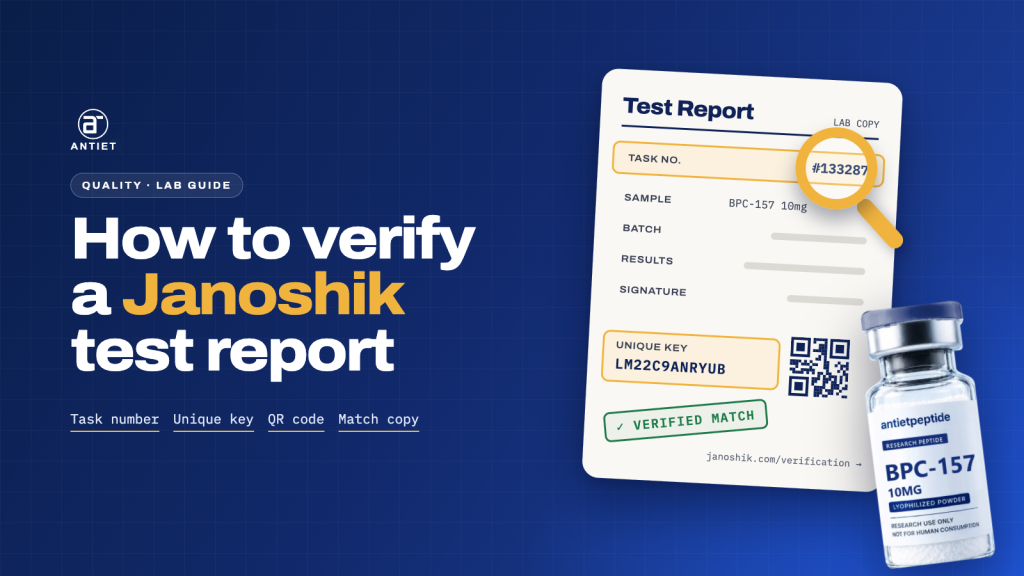
That instinct is sound, but it only works if you can read a peptide COA line by line before comparing copies. Purity and identity come from different instruments, so knowing what HPLC and mass spectrometry each measure keeps those two numbers straight. And a report only counts once you verify a Janoshik test report against the version stored in the lab’s own database.
FAQs
Why is Ipamorelin banned?
The WADA Prohibited List includes Ipamorelin by name under S2.2.4, growth hormone secretagogues and their mimetics, prohibited at all times in tested sport; the 2026 list took effect 1 January 2026. Separately, it is an unapproved drug in the US, with no authorised medical use.
What adverse events have been reported in Ipamorelin studies?
In the published Phase 2 ileus trial, treatment-emergent adverse events occurred in 87.5% of Ipamorelin patients versus 94.8% on placebo, and the authors described the compound as well tolerated. Specific event types were not detailed in the abstract. All figures come from one post-surgical trial population.
Does Ipamorelin reduce belly fat?
No human trial has tested Ipamorelin for fat or body-composition endpoints. The visceral-fat data this question usually traces back to belongs to tesamorelin as the approved drug Egrifta, from controlled trials in HIV-associated lipodystrophy. Those results describe that medicine in that population, nothing else.
How is Ipamorelin different from sermorelin?
They work through different receptors: Ipamorelin mimics ghrelin at GHS-R1a, while sermorelin is a GHRH fragment acting on the GHRH receptor. Ipamorelin is a 5-amino-acid synthetic design from Novo Nordisk; sermorelin is a 29-amino-acid natural-sequence fragment that was once the approved drug Geref.
Have tesamorelin and Ipamorelin been studied together?
No controlled trial of the combination has been published. Each compound’s evidence exists separately: tesamorelin through Egrifta’s approval program, Ipamorelin through its pharmacology papers and two Phase 2 gut-recovery trials. Any claim about the pair working together is extrapolation, and no study supports or refutes it.
Is Ipamorelin FDA-approved?
No. Ipamorelin has never been approved by the FDA for any indication. Since 29 September 2023, the agency has listed Ipamorelin acetate in Category 2 of its compounding bulk-substances lists, the category for substances that may present significant safety risks, and it is not on the 503A bulks list.
Is Ipamorelin the same as CJC-1295?
No. They belong to different classes: Ipamorelin is a ghrelin mimetic at GHS-R1a, while CJC-1295 is a GHRH analog at the GHRH receptor. Research pairs them precisely because the receptors differ, and the two mechanisms ship together in one vial as a CJC-1295 + Ipamorelin blend.
Ipamorelin’s record is unusually complete for a research peptide: a named inventor company, a landmark selectivity paper with real numbers, human pharmacokinetics, and two registered trials with an unflattering, fully published outcome. That paper trail is the standard your sourcing should match. Every Ipamorelin batch at Antiet ships with an independently verifiable certificate of analysis, so the documentation habit the research demands is already built in.
Sources
- Raun K, Hansen BS, Johansen NL, Thøgersen H, Madsen K, Ankersen M, Andersen PH. Ipamorelin, the first selective growth hormone secretagogue. Eur J Endocrinol 1998;139(5):552-61. https://pubmed.ncbi.nlm.nih.gov/9849822/
- Gobburu JV, Agersø H, Jusko WJ, Ynddal L. Pharmacokinetic-pharmacodynamic modeling of Ipamorelin, a growth hormone releasing peptide, in human volunteers. Pharm Res 1999;16(9):1412-6. https://pubmed.ncbi.nlm.nih.gov/10496658/
- Beck DE, Sweeney WB, McCarter MD; Ipamorelin 201 Study Group. Prospective, randomized, controlled, proof-of-concept study of the ghrelin mimetic Ipamorelin for the management of postoperative ileus in bowel resection patients. Int J Colorectal Dis 2014;29(12):1527-34. https://pubmed.ncbi.nlm.nih.gov/25331030/
- ClinicalTrials.gov. NCT00672074 (completed 2009) and NCT01280344 (completed 2014), sponsor Helsinn Therapeutics (U.S.), Inc. Accessed 20 November 2026. https://clinicaltrials.gov/study/NCT00672074
- Dominikowski A, Rękoś Z, Olejarz M, Szczepanek-Parulska E, Domin R, Ruchała M. Review of peptides modulating the GH-IGF1 axis: clinical evidence and self-administration. Front Endocrinol 2026. https://doi.org/10.3389/fendo.2026.1822475
- US Food and Drug Administration. Certain Bulk Drug Substances for Use in Compounding that May Present Significant Safety Risks. Ipamorelin acetate entry dated 29 September 2023. https://www.fda.gov/drugs/human-drug-compounding/certain-bulk-drug-substances-use-compounding-may-present-significant-safety-risks
- US Food and Drug Administration. Pharmacy Compounding Advisory Committee briefing document, Ipamorelin, meeting of 29 October 2024. https://www.fda.gov/media/182088/download
- US Food and Drug Administration. EGRIFTA (tesamorelin for injection) prescribing information, 2010. https://www.accessdata.fda.gov/drugsatfda_docs/label/2010/022505s000lbl.pdf
- Federal Register. Determination that GEREF (sermorelin acetate) injection was not withdrawn from sale for reasons of safety or effectiveness. 4 March 2013. https://www.federalregister.gov/documents/2013/03/04/2013-04827/determination-that-geref-sermorelin-acetate-injection-05-milligrams-basevial-and-10-milligrams
- World Anti-Doping Agency. The 2026 Prohibited List, section S2.2.4. In force 1 January 2026. https://www.wada-ama.org/en/prohibited-list
- National Center for Biotechnology Information. PubChem Compound Summary, CID 9831659, Ipamorelin. https://pubchem.ncbi.nlm.nih.gov/compound/9831659
- Peptide Critic community. Thread on independent re-testing of a GH-peptide vial, 23 April 2026. https://community.peptidecritic.com/topic/1206/nexaph-cjc-ipa-test-results-a-lot-lower-than-janoshik-s
Antiet products are supplied for in vitro laboratory research use only. They are not for human or veterinary use, and are not drugs, foods, cosmetics or supplements. The Antiet Terms of Sale set out the full conditions of supply.
This article is for general laboratory information only. Antiet products are sold strictly for research use and are not for human or veterinary use.